Event 1
Wrecker Island sligger extermination
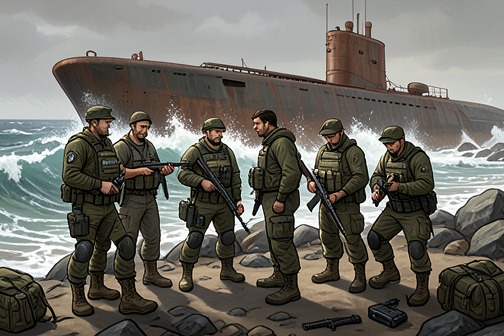
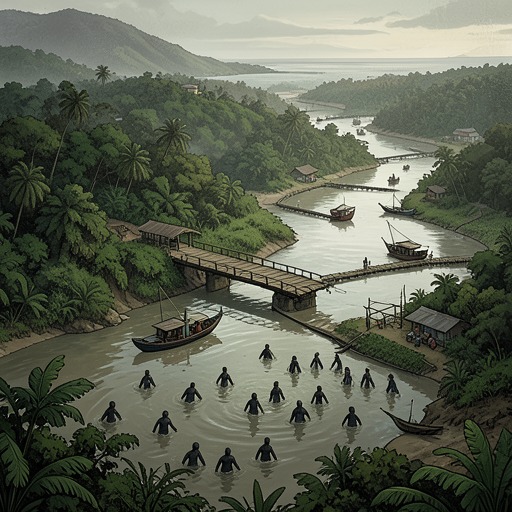
The [Wrecker Island sligger extermination](entity:event-recall-event-wrecker-island-sligger-2b0be2d77887) was the costly operation that ended the immediate threat to [Sweetboro](entity:location-recall-location-sweetboro-a5aa48839f69) by destroying the creatures and their eggs on the island where they had originated. Led by Sheriff [Mason Parker](entity:character-recall-character-mason-parker-89e6e9e56699) with assistance from Captain [Josh Moody](entity:character-recall-character-josh-moody-abb95c0f8066) and fourteen state troopers, the mission also exposed the danger of the contamination associated with the island’s Nazi submarine wreck: eliminating the animals was not enough unless their remains and the leaked material were dealt with as well.
## Background and Stakes
The island mission followed an earlier failure of trust. The previous year, a sheriff had called for help, but [Josh](entity:character-recall-character-josh-7784b47d315f) believed that call was a hoax. When the threat required action again, he felt obligated to make amends and brought fourteen troopers from the [South Carolina State Patrol](entity:organization-recall-organization-south-carolina-s-f5a8844da54e) to assist Mason. The operation therefore carried both immediate stakes—the safety of Sweetboro—and the weight of Josh’s earlier disbelief.
The [Sliggers](entity:creature-recall-creature-sliggers-91ee239f1ac5) were described as the likely evolutionary result of generations of sea animals consuming waste from experiments associated with the wreck. The account does not establish the exact substance or precisely how the creatures developed. [Denise Baddington](entity:character-recall-character-denise-baddington-f3dc1168d215)’s later analysis of their tissue yielded no conclusive identification, and she was still awaiting results from residue samples taken from the [Wrecker Island Nazi U-boat](entity:object-recall-object-wrecker-island-nazi-u-54590a6609d4). She suspected that German and Japanese scientists had created a substance capable of inducing genetic mutation when introduced into an organism’s DNA. In her theory, generations of Sliggers had acquired traits from the marine species they ate. This remained an explanation under investigation, not a confirmed laboratory result.
The creatures’ appearance made the biological threat concrete. They stood about five feet tall, with olive-green skin, long reptilian tails, thick amphibious legs, webbed feet, and three pairs of four-foot tentacles tipped with venomous claws. Their heads were roughly the size of a man’s, with protruding snouts, lower jaws extending beyond the upper, needle-like teeth, and large, bulging black eyes. The description underscores why the mission was not simply a cleanup of an obscure environmental hazard: the leak had become a living, lethal danger.
## The Extermination and Its Cost
The mission succeeded in destroying both the creatures and their eggs. Its human cost was severe: ten of the fourteen troopers Josh had brought to the island were killed in the battle. The outcome thus joined a decisive local victory to a substantial loss of life; the town’s later relief did not erase what the operation had demanded of those sent to carry it out.
The work extended beyond killing the animals. Their carcasses were properly disposed of, and the EPA cleaned up the toxic element that had leaked from the submarine, restoring the island’s ecosystem. Those measures addressed two connected risks: surviving eggs could renew the infestation, while contaminated remains or environmental waste could carry the danger onward. The destruction of the island population and the cleanup of its habitat made the operation more complete than a battlefield victory alone.
After returning, Mason was publicly identified as the sheriff responsible for finding and killing the creatures, while Josh and his troopers also received attention for their contribution. Mason was content to share the spotlight and cared little for fame. His public account emphasized that Josh’s assistance had helped prevent another Sligger problem in Sweetboro, because the creatures had been exterminated on the island they originated from before they could settle in town again.
## Lessons for Finding and Destroying Nests
The later response drew on practical lessons Mason described after the island mission. He advised searchers to prioritize nests, which Sliggers favored in dark, wet places: shaded thickets, seaside caves, and other sites where water currents would not disturb them. Finding a nest meant destroying both it and the Sliggers associated with it. This guidance made locating breeding sites, rather than merely reacting to visible animals, central to an effective search.
Mason also warned against simply blowing the creatures apart. Scattering mutated tissue into water could allow other animals to eat it and, in turn, restart the cycle of contamination. [Denise](entity:character-recall-character-denise-829ff5a7cbf3) likewise stressed that responders should recover tissue and collect and burn carcasses cleanly so scavengers could not consume remains carrying mutated DNA. When Ron Mittenfeld briefed troops, he passed on Denise’s warning against explosives. The post-mission protocol therefore treated disposal as part of extermination, not an afterthought.
The source of the danger was still uncertain even as responders adopted these precautions. Mason described the strange experimental material found inside the submarine and the suspicion that it involved genetic mutation or biological warfare, while Denise continued to await laboratory results. The mission established a connection between the wreck, the leak, and the local creatures, but it did not resolve the chemistry or fully explain their evolution. That distinction shaped the subsequent effort: teams had to act on the observed risks while the origin remained under investigation.
## Aftermath and Limits of Victory
In Sweetboro, the immediate result looked conclusive. The people were relieved and grateful, and Mason saw the town as safe again. Yet he remained mentally scarred by the island experience; his nightmares were becoming less frequent, not wholly absent. The operation’s aftermath therefore included both the community’s return to security and the lasting personal consequences of the battle for the sheriff who had led it.
The wider story soon qualified the meaning of the victory. Denise concluded that attacks reported far apart—including a campground in [Georgia](entity:location-recall-location-georgia-6064d11655cc) and [Sligger eggs](entity:object-recall-object-sligger-eggs-5956c01548e6) on a [Florida](entity:location-recall-location-florida-1618e1042117) beach—could not be explained by a single local nest. Multiple nests, eggs, and creatures must be present along the coast, she warned, leaving no reliable way to know where they were before an attack. Later, investigators traced Sliggers moving east along the [Gulf of Mexico](entity:location-recall-location-gulf-of-mexico-6c8da060fe63) with coastal currents, with [Port Arthur](entity:location-recall-location-port-arthur-4c6f8aad7d11), [Texas](entity:location-recall-location-texas-f19b16f8e87c), the furthest-west location reported at that point. The [Wrecker Island](entity:location-recall-location-wrecker-island-4ce6c099ed50) operation had eliminated the island population and restored its ecosystem; it had not eliminated every population elsewhere.
The contrast is central to the event’s significance. At Wrecker Island, coordinated force, nest destruction, and careful disposal could produce a clear local success. Across a connected coastline, however, dispersed nests and waterborne spread made that success difficult to reproduce at scale. The operation became both a model for later search and extermination procedures and a reminder that destroying an apparent point of origin did not guarantee that an invasive threat had stopped spreading.
Event 2
Matty's Death and Nest Discovery at Virginia Beach
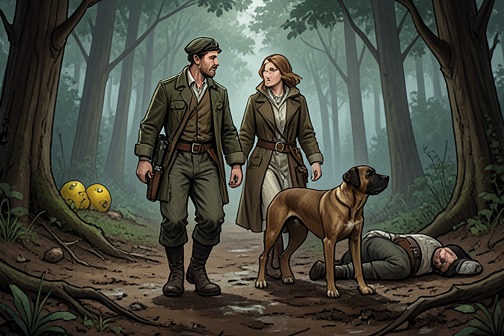
[Matty's Death and Nest Discovery at Virginia Beach](entity:event-recall-event-matty-virginia-beach-002460fb42eb) is the turning point in which a family’s search for their missing son reveals both his mutilated body and a nearby clutch of unknown eggs. The discovery makes the danger immediate: whatever killed Matty may still be in the woods, and the eggs suggest the threat is not an isolated animal encounter.
## The search and the discovery
Darren and Jill enter the woods calling for Matty and their golden retriever, Sadie. When Sadie’s bark finally gives them a bearing, Darren notices a pocket in the ground holding ten objects that look like enormous eggs. Each is about a foot long, dark yellow, and coated in sticky material that holds loose earth to its surface. Their appearance offers no familiar explanation: Darren knows there are no alligators this far north, and the objects do not resemble the eggs of any known bird.
The couple continue toward Sadie, who is only twenty feet farther into the woods. The dog stands rigidly on all four legs, seemingly guarding something, though her tail moves when she sees them. Nearer to her, Darren realizes she is standing over a body. He approaches and finds that the dead figure is not an animal but his son, whose blood-soaked body has been shredded and partly eaten.
Darren falls to his knees in grief. Jill rushes to him and sees the mutilated corpse; the sight leaves her unable to remain standing. The two parents collapse beside each other and sob for several minutes. The scene’s emotional shock is inseparable from its physical evidence: the death is not merely reported, but disclosed to the parents as they reach the place where their child should have been found alive.
## The danger beyond the family
Darren’s grief gives way to immediate fear when he studies Sadie for signs that she attacked Matty. He finds no blood on her snout and concludes that something else killed his son. That distinction does not bring relief: the killer may still be nearby. He urges Jill back toward the house, watching the woods as they leave with Sadie, and means to call the police. Before going, he looks once more at the strange eggs. The scene thus ends not with an explanation, but with two connected warnings—the attacker has not been found, and the clutch remains unexplained.
The wider crisis gives the eggs a significance that the family cannot yet know. Reports from a [Georgia](entity:location-recall-location-georgia-6064d11655cc) campground and [St. Augustine](entity:location-recall-location-st-augustine-e0c5329a1b18) in [Florida](entity:location-recall-location-florida-1618e1042117) lead [Denise](entity:character-recall-character-denise-829ff5a7cbf3) to conclude that separate coastal locations mean multiple nests and creatures, with attacks likely to continue and no reliable way to know where they will appear beforehand. The family’s discovery is therefore legible in retrospect as more than an isolated horror: the eggs point toward a reproducing threat already distributed across a broad area.
Later investigation supplies a suspected biological chain behind that spread. Denise’s tissue analysis yields no conclusive identification, but residue recovered from the Nazi U-boat beneath [Wrecker Island](entity:location-recall-location-wrecker-island-4ce6c099ed50) is suspected of containing a substance designed to induce genetic mutation. She proposes that generations of the creatures acquired traits from the species they ate. Their ability to reproduce asexually and adapt rapidly makes an undiscovered clutch especially consequential: killing visible animals would not necessarily remove a nest or halt the danger.
That ecology also changes how the discovery is understood as a practical problem. Mason advises searchers to look in dark, wet places near water, including shaded thickets and seaside caves, and warns against explosives that could scatter mutated tissue into the water and return it to the food chain. Denise later insists that carcasses be collected cleanly and burned so scavengers cannot spread contaminated remains. The woods where Matty is found become, in the larger account, the first visible point in a crisis that requires not only finding and destroying creatures, but also controlling what their bodies leave behind.
## The later campaign and its limits
Four days after the creatures broke into a hotel room in [Baton Rouge](entity:location-recall-location-baton-rouge-aa3c62d8f78f), [Army Reserve](entity:organization-recall-organization-army-reserve-4a1f0ea4dabd) troops located and destroyed a nest near the edge of the Mississippi. Ron’s team moved north with the searchers as far as [St. Francisville](entity:location-recall-location-st-francisville-8adcf79b8b37); after they found no further nests, they judged that the spread along that route had been stopped. The operation gave the crisis a different scale from the woods where Matty was found: what began as a family’s encounter with an unknown killer had become a coordinated search across waterways.
In his assessment, Ron recorded two traits that complicated any claim of simple containment: the creatures could reproduce asexually and evolve rapidly to adapt to different environments. He also emphasized that the extermination had been carried out without leaving remains that could contaminate the ecosystem. Searchers covered another forty miles of waterways beyond the Baton Rouge nest without finding a monster, while reports from the [Gulf of Mexico](entity:location-recall-location-gulf-of-mexico-6c8da060fe63) described increasingly infrequent encounters. Ron estimated that, given the manpower deployed, the remaining infestation could be eradicated in a relatively short time. That progress offers a qualified resolution to the danger first signaled by the clutch near Matty: nests could be destroyed and the spread checked, but success depended on finding the creatures and preventing their remains from renewing the threat.
## The order of revelation
The discovery unfolds through a reversal of expectations: the familiar bark of Sadie guides Darren and Jill deeper into the woods, but before they reach her, Darren finds the strange eggs. Their unexplained presence first makes the forest feel wrong; the sight of Sadie standing rigidly over Matty then turns unease into personal catastrophe. Because the parents encounter the clutch before they understand what happened to their son, the eggs and the death become linked in the same search without providing an immediate explanation for either. Darren’s glance back at the eggs as he leaves for the house preserves that uncertainty: the family has found evidence of a larger danger, but not its killer or its cause.
Event 3
Sligger Egg Discovery on St. Augustine Beach
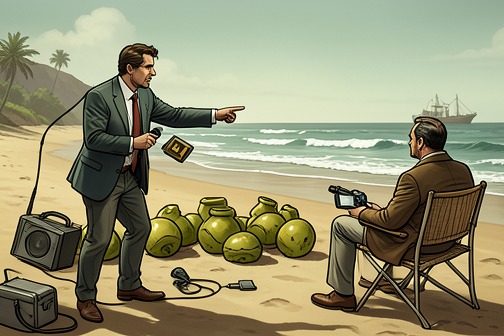
The [Sligger Egg Discovery on St. Augustine Beach](entity:event-recall-event-st-augustine-sligger-0c7ef1b4649c) is the first unmistakable sign in the supplied scenes that the Sligger threat has spread far beyond the outbreak [Mason Parker](entity:character-recall-character-mason-parker-89e6e9e56699) had already encountered. Seen not in a nest or during an attack, but in a television report over a sheriff’s meal, the eggs change the meaning of the crisis: the danger is no longer confined to a known site, and its next appearance may be elsewhere along the coast.
## Discovery on the Beach
A news camera in [St. Augustine](entity:location-recall-location-st-augustine-e0c5329a1b18), [Florida](entity:location-recall-location-florida-1618e1042117), shows a reporter pointing toward half a dozen oblong objects bunched together on white sand. They resemble greenish-yellow reptile eggs, each about the size of a football. The report offers no explanation of where they came from or how long they have been there. The image itself supplies the essential evidence: [Sligger eggs](entity:object-recall-object-sligger-eggs-5956c01548e6) have appeared at a new location.
Mason drops his fork because he recognizes what the television is showing. He tells [Eaver Robinson](entity:character-recall-character-eaver-robinson-6ca7b53d756e) that the news has just shown more Sligger eggs, then fixes on the distance separating St. Augustine from the places he knows. His question about how they could have reached Florida remains unanswered. Eaver, watching the report, is too stunned to reply. The scene’s quiet domestic setting makes the revelation sharper: an image from a beach interrupts an ordinary meal and brings the danger into the room without warning.
## From a Finding to a Coastal Pattern
The report becomes more alarming as other locations enter the investigation. Mason tells a trooper that a campground in [Georgia](entity:location-recall-location-georgia-6064d11655cc) was attacked the previous night and that the St. Augustine eggs had appeared in clear news footage. Because the locations are too far apart to be treated as one local nest, [Denise Baddington](entity:character-recall-character-denise-baddington-f3dc1168d215) infers that there must be multiple nests, eggs, and creatures along the coast. Her conclusion is a warning, not a complete map: the creatures could be anywhere, and authorities may not know where until an attack occurs. She expects further attacks and fears that many people will die.
Later information from a Florida sheriff confirms two attacks during the same night. One occurred near the St. Augustine egg discovery; the other was near [Sawgrass](entity:location-recall-location-sawgrass-3f414c3453d3), about twenty miles farther north. The sheriff describes a call from a motel on [St. Augustine Beach](entity:location-recall-location-st-augustine-beach-f7ef53593375): after a domestic-disturbance call around 10 p.m., the motel called again to report animals attacking guests. Officer Mullins arrived, called animal control, and was waiting for them when screams led her to move in and help. The available account establishes the attacks and the officer’s response, but does not establish that the eggs caused either attack.
Together, the beach report and the geographically separate incidents turn a striking image into a problem of distribution. Later, investigators conclude that coastal currents carried [Sliggers](entity:creature-recall-creature-sliggers-91ee239f1ac5) along the [Gulf of Mexico](entity:location-recall-location-gulf-of-mexico-6c8da060fe63), moving east from somewhere west of the affected area. [Port Arthur](entity:location-recall-location-port-arthur-4c6f8aad7d11), on the [Texas](entity:location-recall-location-texas-f19b16f8e87c)-[Louisiana](entity:location-recall-location-louisiana-2de999a335e6) border, is the furthest-west reported location they identify. This later route hypothesis offers a possible explanation for movement through connected waters; it does not resolve how the eggs reached St. Augustine in the first place.
## The Search and the Biological Risk
The discovery also changes what an effective response must accomplish. Mason advises that finding nests is more important than simply confronting individual creatures. Sliggers favor dark, wet places, including shaded thickets and seaside caves, where water currents are unlikely to disturb a nest. Once located, nests and the Sliggers associated with them must be destroyed. Searchers later move through [Emerald Isle Woods Park](entity:location-recall-location-emerald-isle-woods-p-4c789cad7055) along forest trails and an elevated wooden walkway over low ground, scanning the brush for signs of nests or creatures. The careful search gives practical form to the warning raised by the beach footage: a visible clutch can signal a larger, concealed breeding problem.
The danger extends beyond the living animals. Mason warns against blowing them apart and scattering mutated tissue into the water, where other animals could eat it and continue the cycle. [Denise](entity:character-recall-character-denise-829ff5a7cbf3) likewise stresses the importance of recovering all tissue and cleanly collecting and burning carcasses so scavengers cannot feed on remains containing mutated DNA. The eggs therefore signify more than the possibility of another attack; they belong to a crisis in which careless extermination could help carry biological contamination into the food chain.
The proposed origin remains uncertain during the investigation. Denise’s tissue analysis has not conclusively identified the creatures, and residue samples from the [Wrecker Island Nazi U-boat](entity:object-recall-object-wrecker-island-nazi-u-54590a6609d4) are still awaiting test results. She suspects that a substance created by German and Japanese scientists to induce genetic mutation may explain the creatures’ mixed marine characteristics, acquired over generations as they fed on other species. Mason similarly tells the Florida sheriff that an unknown substance leaked into the ocean many years earlier, while making clear that laboratory results are still pending. These accounts connect the outbreak to a possible historical environmental source without presenting the suspected compound or its effects as conclusively proven.
## Consequences and Retrospective Significance
The St. Augustine report helps precipitate a broader warning effort. Denise identifies [Gina Taylor](entity:character-recall-character-gina-taylor-251aff2de5b1), her contact at the [U.S. Fish and Wildlife Service](entity:organization-recall-organization-u-s-fish-and-wil-fcda5a1300d0), as someone she can notify; later, [Ron Tully](entity:character-recall-character-ron-tully-88a6cd8c2ea9) agrees that the public and coastal law-enforcement agencies must be informed, despite the risk of public panic. The discovery thus shifts the response from local reaction toward coordinated coastal surveillance and nest-clearing, while the threat of contaminated remains makes disposal procedures part of that response.
The crisis is eventually described as receding rather than advancing unchecked. Four days after Sliggers break into a hotel room in [Baton Rouge](entity:location-recall-location-baton-rouge-aa3c62d8f78f), [Army Reserve](entity:organization-recall-organization-army-reserve-4a1f0ea4dabd) troops locate and destroy a nest near the [Mississippi River](entity:location-recall-location-mississippi-river-50469fcfa0c8). Ron’s team continues north with the searchers; no further nests are found as they cover another forty miles of waterways and reach [St. Francisville](entity:location-recall-location-st-francisville-8adcf79b8b37). Ron’s assessment reports that the spread up the river has been eliminated, that the creatures found were exterminated without leaving contaminating remains, and that reports from the Gulf of Mexico are positive. The account does not identify the St. Augustine eggs as the source of the later spread or establish their individual fate. Their significance lies instead in the reversal they mark: what had seemed a contained monster problem is exposed as a dispersed coastal emergency, requiring authorities to search not only for creatures but for hidden nests and the ecological traces their destruction might leave.
Event 4
Richmond Lab Hatching and Electrocution
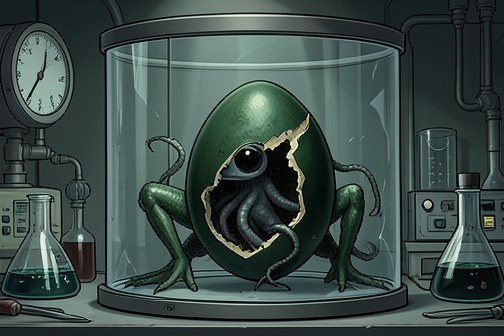
The [Richmond Lab Hatching and Electrocution](entity:event-recall-event-richmond-0b7e8e78e901) begins as an attempt to study an unidentified egg and becomes the first direct laboratory encounter with young [Sliggers](entity:creature-recall-creature-sliggers-91ee239f1ac5). [Leslie Bickers](entity:character-recall-character-leslie-bickers-062efa0dada6) cannot identify the animal developing inside, even under 400X magnification. When the egg begins to move, she returns it to the tank beside two others; almost immediately, its shell ruptures and the creature inside forces its way out. The hatching reveals both the animals’ startling anatomy and the threat they pose when confined only by laboratory equipment.
## Hatching and Containment
The first hatchling emerges in stages: a dark-green head slick with amniotic fluid, jet-black eyes, a long-toothed jaw, three pairs of tentacle-like appendages, amphibious legs, and a reptilian tail. Its mixture of features appears to span at least four animal classes, defying Leslie’s biological expectations. As the creature pulls itself from the egg, the other two begin to open as well. What might have been a close examination of one specimen is suddenly the emergence of three.
The first hatchling reacts aggressively to Leslie. It hisses, charges the Plexiglas, and tries to climb out through the open top. She quickly secures the steel mesh cover over the tank. The animal continues searching for a way out, and its newly alert siblings join the effort, striking the cover with enough force to make Leslie reinforce it with thick textbooks. The improvised weight holds the lid down for the moment, but their vigorous attacks make plain how precarious the enclosure is.
As Leslie watches the creatures, fascination gives way to recognition. Their appearance matches accounts of sea monsters reported in [South Carolina](entity:location-recall-location-south-carolina-0e7f9eaed279) the previous year and again in recent news: recovered body parts and witness descriptions now have a living counterpart in the tank. The laboratory scene therefore connects the anomalous eggs to an already unfolding coastal threat. Its immediate danger is contained, but the resemblance identifies the hatchlings as part of a wider crisis rather than an isolated scientific puzzle.
## Escalation and Destruction
The hatchlings’ danger becomes undeniable when two turn on the third. They tear into it from opposite sides; within a minute, the victim lies lifeless, shredded, and open, while the surviving pair begin to feed. The laboratory’s specimens are not merely aggressive toward people: they are predators capable of killing and consuming one another. Earlier testing had made the danger measurable in another way. A mouse placed in the tank was stung by the creatures’ barbed tentacles and died in four minutes; almost all of it was eaten, with the remains left underwater.
Once the surviving hatchlings have fed, they turn their attention back to the people watching them. They strike the Plexiglas with their appendages and ram the tank hard enough to shake it. The group steps back as another lunge shoves the entire tank an inch closer to the counter’s edge. Above it, the steel mesh rattles despite the heavy textbooks still holding it down. The makeshift enclosure that had kept the newly hatched animals inside now appears close to failing under their repeated assaults.
[Ron Tully](entity:character-recall-character-ron-tully-88a6cd8c2ea9) concludes that keeping the hatchlings alive is no longer safe: they must be destroyed before they escape and attack. A scalpel would require someone to reach close enough to be stung, while fire would be ineffective in a water-filled tank. He instead takes a desk lamp, pulls its cord away from the base, checks that the wires are exposed, and feeds them through an opening in the mesh. Electricity from the outlet spreads through the tank water. The hatchlings convulse as the current seizes their muscles, then fall limp when their hearts stop. Their destruction ends the immediate laboratory threat, but the encounter has also shown how quickly a contained specimen can turn into an emergency.
## Scientific Meaning and Ecological Stakes
The laboratory could display what the hatchlings were, but not explain how they had come to be. Their combination of traits from several animal classes suggested profound biological disruption; later tissue analysis by [Denise Baddington](entity:character-recall-character-denise-baddington-f3dc1168d215) still yielded no conclusive identification. Samples of residue recovered from the old Nazi U-boat beneath [Wrecker Island](entity:location-recall-location-wrecker-island-4ce6c099ed50) had not yet produced test results, so the proposed cause remained a hypothesis rather than a confirmed finding.
[Denise](entity:character-recall-character-denise-829ff5a7cbf3) suspected that the substance developed by German and Japanese scientists had been intended to induce genetic mutation when introduced into an organism’s DNA. In her account, generations of creatures feeding on other species could acquire and mutate with the DNA of their prey, helping explain their mixed characteristics. The hatchlings’ bodies thus became an ominous piece of evidence in a larger investigation: a visible biological anomaly whose origin was thought to lie in a long-ago leak into the ocean.
The danger extended beyond any creature escaping the tank. Later guidance stressed that killing Sliggers carelessly could spread their mutated tissue through the water, where other animals might eat it and continue the contamination through the food chain. Denise therefore urged responders to recover all tissue and burn the carcasses cleanly. In retrospect, the hatchlings’ destruction addressed the immediate threat to the laboratory staff, while the conditions that produced the animals demanded a wider form of containment—one concerned not only with living predators, but also with what their remains might pass on.
## From Laboratory Specimens to a Regional Emergency
The [Richmond](entity:location-recall-location-richmond-68f62839f944) hatchlings’ behavior was an early warning of the larger problem, not an isolated laboratory danger. As reports accumulated from a [Georgia](entity:location-recall-location-georgia-6064d11655cc) campground and a [Florida](entity:location-recall-location-florida-1618e1042117) beach near [St. Augustine](entity:location-recall-location-st-augustine-e0c5329a1b18), Denise Baddington concluded that the widely separated incidents pointed to multiple nests, eggs, and creatures along the coast. Later assessments traced another route of spread to coastal currents in the [Gulf of Mexico](entity:location-recall-location-gulf-of-mexico-6c8da060fe63), carrying Sliggers eastward from the [Texas](entity:location-recall-location-texas-f19b16f8e87c)-[Louisiana](entity:location-recall-location-louisiana-2de999a335e6) border. The crisis was therefore not simply a matter of one enclosure failing: nests and waterways connected local encounters into a broad, moving infestation.
The response eventually depended on finding nests and eliminating them before the creatures could spread farther. Four days after the hotel attack in [Baton Rouge](entity:location-recall-location-baton-rouge-aa3c62d8f78f), [Army Reserve](entity:organization-recall-organization-army-reserve-4a1f0ea4dabd) troops located and destroyed a nest near the [Mississippi River](entity:location-recall-location-mississippi-river-50469fcfa0c8). Ron Tully’s team continued north with the searchers as far as [St. Francisville](entity:location-recall-location-st-francisville-8adcf79b8b37); after they covered another forty miles of waterways without finding a monster, officials judged that the spread up the river had been stopped. Ron’s report also noted two traits with consequences beyond the Richmond incident: the animals could reproduce asexually and evolve rapidly in response to different environments. The laboratory episode had shown the immediate danger of hatching and containment; the later campaign revealed the scale of the work required to prevent that danger from becoming an ecological invasion.
Event 5
Port Republic Pier Attack and Dennis's Death
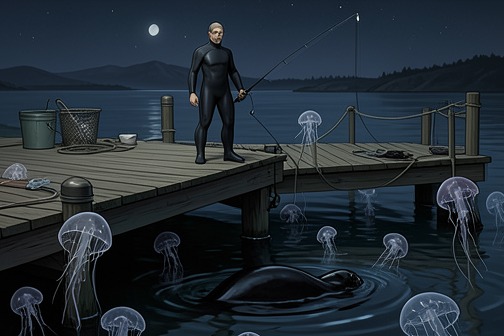
The [Port Republic Pier Attack and Dennis's Death](entity:event-recall-event-port-republic-dennis-21ef0e003d5d) is a nighttime Sligger attack on a fishing pier in [Chesapeake Bay](entity:location-recall-location-chesapeake-bay-83977bff6fec), ending with Dennis pulled beneath the water and fatally mauled. Its force comes from the collision of familiar coastal routines with a sudden, coordinated assault: the bay Dennis visits for food and recreation becomes the route by which the creatures surround him, and the water he chooses for escape becomes the place he is caught.
## Setting and warning signs
Dennis comes to the bay in summer, carrying a fishing pole and tackle box down timber steps to a small beach and then along a wooden pier extending two hundred feet from shore. A cool northern breeze has brought the temperature to around seventy degrees. The ordinary details establish a landscape he knows well, where he can expect to catch blue crabs or fish and where he has previously handled jellyfish caught on his hooks.
Under the pier lights, jellyfish fill the water, their tentacles extended as they feed. Dennis has noticed that moon jellies and sea nettles seem to grow more abundant each year, and attributes the increase to climate change. More striking to him that night is what is missing: no blue crabs cling to the piles beneath the pier, although they are usually visible there and can sometimes be scooped up with his long-handled net. The scene marks this absence as an anomaly, but does not establish its cause.
Dennis is fishing for striped bass, which can grow four or five feet long. He knows that fish under nineteen inches cannot legally be kept and finds catch-and-release satisfying in its own right. After one cast brings up a jellyfish about four inches wide, he puts on a thick work glove, removes it from the hook, and tosses it back. On his next cast, something hits the lure with enough force almost to wrench the pole from his hands. The line snaps. As Dennis bends over his tackle box to change lures, slight movement stirs the water below.
## The attack on the pier
A sulfurous smell alerts Dennis to something strange. He first sees what looks like a black snake fastening itself to one of the pier piles; then a second shape attaches itself with a sharp tip. The resemblance to snakes gives way to recognition when the head of a large, dark creature appears between the appendages. Another Sligger climbs up behind him, reaches the end of the pier, fixes its eyes on him, and hisses.
The creatures have not simply appeared at the edge of the water: they are climbing onto the structure around him. One tentacle strikes a plank and narrowly misses Dennis's foot. He drops what he is carrying and runs toward the beach, only to stop after about thirty feet when two more [Sliggers](entity:creature-recall-creature-sliggers-91ee239f1ac5) pull themselves onto the pier near the shore end and scuttle toward him. The escape route has closed from both directions. Counting the creatures that appear in this sequence, at least five are on or approaching the pier, turning a single frightening sight into a coordinated encirclement.
Dennis looks up toward his house on the hillside and calls for his wife, Claire. The house remains dark and quiet; he believes she is probably asleep. Faced with the attacking creatures and their jaws, he chooses the water rather than remain trapped on the pier. Swimming diagonally toward the beach and away from the structure offers a possible route out, but it means entering cold water in heavy clothing among the jellyfish he has been handling all evening.
## Flight and death
Dennis dives in and swims frantically for shore. Adrenaline keeps him from registering the chill at first, but the jellyfish sting his hands, and a sea-nettle tentacle brushes across his face with a burning pain. His clothes protect much of his body, not all of it. He continues despite the stings, while splashes behind him suggest that the creatures from the pier have entered the water and are pursuing him.
He calls for Claire again, this time with seawater entering his mouth. His hands and face are nearly numb, but the stings still hurt. His strength ebbs under the combined weight of his clothing, the accumulated pain, and his poor physical condition; his swimming slows. Then a light comes on in the house. Claire appears as a silhouette at the patio door and steps outside. Dennis calls to her, but the moment of possible rescue is cut short: something seizes his leg and yanks him deep beneath the surface.
Underwater, Dennis panics and strikes out blindly, but cannot break free. The creatures slice open his chest and belly; seawater replaces the air in his lungs. His last conscious sensation is multiple mouths biting him. The attack thus ends not with a reported recovery or rescue, but with his death in the water, after Claire has reached the door but before she can help him.
## Significance within the outbreak
The pier attack makes the danger of the Sliggers concrete in a setting that had seemed familiar and usable. Dennis knows the fishing routines, the legal limit for keeping striped bass, the jellyfish's stinging tentacles, and the practical value of his work glove. That knowledge helps him manage ordinary risks, but cannot prepare him for creatures that climb the pier, block the route to shore, and pursue him into the bay. The expected refuge of water becomes an extension of the attack.
The event also belongs to an outbreak already extending beyond one location. Mason reports an attack at a campground in [Georgia](entity:location-recall-location-georgia-6064d11655cc) and video of [Sligger eggs](entity:object-recall-object-sligger-eggs-5956c01548e6) on a beach in [St. Augustine](entity:location-recall-location-st-augustine-e0c5329a1b18); [Denise](entity:character-recall-character-denise-829ff5a7cbf3) reasons that the distance between the sites means multiple nests, eggs, and creatures may be spread along the coast. Her warning that people will be killed is given an immediate human consequence in Dennis's fate. Later, Denise explains that tissue analysis has not identified the creatures conclusively and describes a theory that a mutagenic substance from the Nazi U-boat beneath [Wrecker Island](entity:location-recall-location-wrecker-island-4ce6c099ed50) may account for their mixed marine characteristics. Elsewhere in the crisis, coastal currents are identified as a route by which Sliggers have moved along the [Gulf of Mexico](entity:location-recall-location-gulf-of-mexico-6c8da060fe63), while a later search following the [Baton Rouge](entity:location-recall-location-baton-rouge-aa3c62d8f78f) nest destruction covers forty more miles of waterways without finding another nest. These developments broaden the ecological and geographic frame; they do not establish a direct cause for the missing crabs at Dennis's pier or make his death the result of a subsequent eradication effort.
Event 6
Battery Park and Manhattan Sewer Attacks
The [Battery Park and Manhattan Sewer Attacks](entity:event-recall-event-battery-park-71ead7b72c13) reveal how [Sliggers](entity:creature-recall-creature-sliggers-91ee239f1ac5) can turn an ordinary urban night into two simultaneous hunts, one in a public park and the other beneath the streets. Five creatures emerge from cover after a couple has left the waterfront, divide into separate groups, and find prey in places where people believe themselves briefly safe: a park bench and a dry underground chamber. The attacks bring the danger of the coastline’s spreading nests into the city’s greenery and sewer network.
Event 7
Savannah Civilian Hunters' Nest Encounter
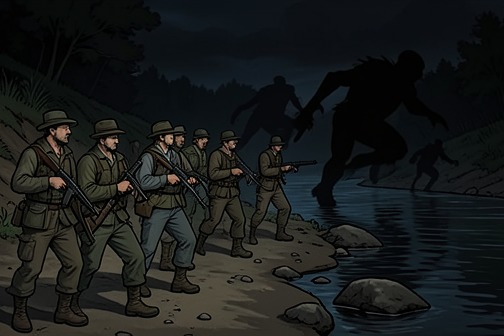
The [Savannah Civilian Hunters' Nest Encounter](entity:event-recall-event-5873a9f98d44) turns a public response to the Sligger emergency into a direct, improvised confrontation: a group of civilians finds a nest along the [Savannah River](entity:location-recall-location-savannah-river-135a3a60af07), destroys its eggs, and is immediately attacked by the adult creatures drawn from the surrounding cover.
## Mobilization and Approach
The hunt took shape amid growing alarm over Sligger appearances along the [East Coast](entity:location-recall-location-east-coast-7405f96629bf). National broadcasts urged people to stay indoors at night and avoid the water until authorities declared areas safe, while social media spread the warning in a less solemn form through monster-movie memes. [Savannah](entity:location-recall-location-savannah-d61b1a30d8f4)’s police concentrated their search along the river after the campground attack on [Jekyll Island](entity:location-recall-location-jekyll-island-7cbdcc811b4c). At the same time, civilian teams began organizing their own searches, looking for places outside populated areas where they could carry guns without interference from law enforcement.
[Molly Foster](entity:character-recall-character-molly-foster-b720a99f9d0b) assembled six people for a nighttime search. Raised in a military family, comfortable with firearms, and taught to hunt by her father, she brought her best shotgun. Her younger brother joined her, as did friends including [Gary Bracken](entity:character-recall-character-gary-bracken-9727390d883a); two of the party, massage clients of Molly’s, were nervous about facing the dangerous creatures but eager to take part. They parked near [Old Fort Jackson](entity:location-recall-location-old-fort-jackson-03d3f7f528ef), three miles from [River Street](entity:location-recall-location-river-street-6197e3810cba), and gathered after dark. The hunters checked their ammunition and flashlights, and wore rubber chest waders in anticipation of slogging through water.
Molly led the group from the closed entrance gate, along the fenceline and around to the river, then east with the lights of River Street behind them. Their first stretches of shoreline offered little promising cover: the dense riprap by the fort and the bright, similarly rocky bank at the SeaPoint Industrial Terminal left few places where a large animal could nest. They moved on, also conscious that the industrial site’s security personnel might intercept them. When they reached muddier ground, Molly kept the group searching the shore rather than the water, following the report that [Sliggers](entity:creature-recall-creature-sliggers-91ee239f1ac5) placed their nests on land so waves would not wash away or disturb the eggs. The spongy, pungent pluff mud slowed their footing, while the waders kept the muck from pulling off their boots.
## Nest Discovery and Attack
As the hunters moved into thicker grass, Molly Foster’s flashlight picked out bright objects among the cutgrass. She recognized them as eggs and alerted the group. Half a dozen lay tucked together, each about a foot long—far too large to be alligator eggs. The hunters identified them as [Sligger eggs](entity:object-recall-object-sligger-eggs-5956c01548e6), and Ryan asked whether they should blast them. Molly agreed that the nest had to be destroyed.
Molly stepped back and fired her shotgun into the nest. The blast broke apart the eggs, scattering sticky debris through the grass. Some of the young inside were plainly dead, but several damaged offspring still twitched. Ryan fired into them as well, killing the survivors. The destruction was decisive, but it also marked the moment the search became a fight: sulfur stink rose around the hunters, overpowering the smell of the pluff mud, and the surrounding brush began to move.
Four Sliggers erupted from the foliage and converged on the group. Gary Bracken and Dave fired first, striking two creatures and knocking them backward. The shots startled Robbie and Steve into pulling their own triggers; Steve’s blast brought down a third. The last creature came almost within striking range before Molly lined up its head and fired. Her shot burst its head, stopping the attack. The sudden silence left the group momentarily stunned; then Ryan’s excitement broke through, while Steve shook with disbelief and Robbie congratulated him for killing one. Molly said her heart was pounding with adrenaline, and the others also needed time for their pulses to settle.
Molly called the police, reported the encounter, and gave the location of the bodies so they could be disposed of. Although she considered continuing the hunt downriver, it was late and the group was already two miles from its trucks. She chose to end the search for the night and wait for the authorities before returning.
## Aftermath and the Limits of the Search
Molly’s decision to stop for the night left the wider task unresolved. While the group waited for police, she considered the distance still to cover: from their position, another ten miles of river ran to the Atlantic, without counting the sprawling inlets or the shores of the many islands. The stretch they had just searched was therefore only a small part of a branching waterside terrain, and Molly judged that searching those waterways could take months. The encounter had shown that an armed civilian party could destroy a nest and survive an attack, but it also exposed how little one successful sweep could establish about the area’s safety.
The confrontation became one episode in a continuing pattern of searches and cleanup along the Savannah River. Later, when a national emergency bulletin renewed her determination to help, Molly called Deputy Norman Linneman, who had responded on three occasions when she and her crew destroyed nests along the river. Their repeated encounters had turned the aftermath into a familiar point of contact: the last time he saw her, he had joked that they needed to find better places to meet. That recurrence links the hunters’ first nest encounter to the larger labor of locating and removing threats, while underscoring the gap between a dramatic victory on one stretch of shore and the months of searching the surrounding waterways might demand.
## Ecological Stakes and Uncertainty
The encounter also belonged to a crisis whose causes remained unsettled. [Denise Baddington](entity:character-recall-character-denise-baddington-f3dc1168d215) had found no conclusive answer in her tissue analysis. Residue collected from the Nazi submarine beneath [Wrecker Island](entity:location-recall-location-wrecker-island-4ce6c099ed50) was still awaiting test results, though she suspected it might be a compound designed to induce genetic mutation. In her theory, creatures that fed across marine species could acquire further changes through generations, accounting for their mixture of traits. [Ron Tully](entity:character-recall-character-ron-tully-88a6cd8c2ea9) considered the hypothesis plausible in light of the genetic experiments pursued during [World War II](entity:time-recall-time-world-war-ii-d4353dde1684), but it remained a theory rather than a confirmed explanation. The nest along the Savannah River was therefore evidence of an immediate local danger, not a resolution of how the creatures had come to exist.
The geography made that uncertainty consequential. [Denise](entity:character-recall-character-denise-829ff5a7cbf3) had reasoned that reports from places as far apart as [Georgia](entity:location-recall-location-georgia-6064d11655cc) and [St. Augustine](entity:location-recall-location-st-augustine-e0c5329a1b18) could not be explained by one nearby nest: multiple nests and creatures must be present along the coast. Later, investigators concluded that coastal currents had carried Sliggers eastward along the [Gulf of Mexico](entity:location-recall-location-gulf-of-mexico-6c8da060fe63) from farther west, with [Port Arthur](entity:location-recall-location-port-arthur-4c6f8aad7d11) then the westernmost reported location. Against that expanding pattern, the hunters’ discovery demonstrated both the value and the limits of a local search. They could find and destroy eggs, but the network of waterways, inlets, and islands left no basis for treating one cleared shoreline as proof that the wider region was safe.
Event 8
Federal Mobilization for an East Coast Sligger Sweep
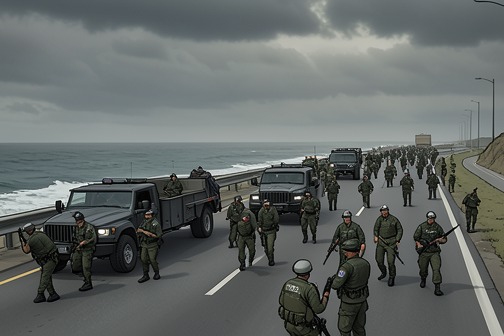
[Federal Mobilization for an East Coast Sligger Sweep](entity:event-recall-event-5d635cb00243) is the shift from scattered warnings and local searches to a coordinated, multistate campaign involving governors, the [National Guard](entity:organization-recall-organization-national-guard-677bd1cd70b9), the [United States Coast Guard](entity:organization-recall-organization-united-states-co-bb57644e9f4c), local law enforcement, and military units. Its urgency rests on two linked problems: attacks were appearing too far apart to be explained by a single nest, while the [Sliggers](entity:creature-recall-creature-sliggers-91ee239f1ac5)’ ability to reproduce nearly as quickly as they grew threatened to outpace the response. The campaign’s central challenge is therefore both geographic and administrative: finding nests across an extensive coast and waterways, while coordinating forces that entered the effort through different levels of government.
## Warnings and the scale of the threat
The mobilization begins as a response to accumulating evidence rather than to one contained outbreak. After attacks at locations too distant from each other to be related, [Denise Baddington](entity:character-recall-character-denise-baddington-f3dc1168d215) reasoned that multiple nests, eggs, and creatures must be distributed along the coast. The possibility that the animals could be anywhere, with their locations becoming known only after an attack, turned the problem into a public-safety emergency. [Eaver Robinson](entity:character-recall-character-eaver-robinson-6ca7b53d756e) asked whether someone in government could issue a national warning; [Denise](entity:character-recall-character-denise-829ff5a7cbf3) identified [Gina Taylor](entity:character-recall-character-gina-taylor-251aff2de5b1), her contact at the [U.S. Fish and Wildlife Service](entity:organization-recall-organization-u-s-fish-and-wil-fcda5a1300d0), as a route for notifying federal officials. [Mason Parker](entity:character-recall-character-mason-parker-89e6e9e56699) agreed that the public needed to be told as soon as possible.
Reports from [Florida](entity:location-recall-location-florida-1618e1042117) sharpened the geographic warning. Two attacks had occurred the previous night: one near the eggs found on [St. Augustine Beach](entity:location-recall-location-st-augustine-beach-f7ef53593375), and another near [Sawgrass](entity:location-recall-location-sawgrass-3f414c3453d3), about twenty miles north. The separate sites reinforced the fear that the known incidents represented only part of a wider infestation. In a later discussion, [Josh Moody](entity:character-recall-character-josh-moody-abb95c0f8066) stressed that Sliggers could reproduce almost as fast as they grew, making their numbers liable to exceed what responders could handle. Mason called for both a public warning and notification of police departments along the coast. [Ron Tully](entity:character-recall-character-ron-tully-88a6cd8c2ea9) agreed to have his superiors alert the media and contact law-enforcement agencies, an early effort to connect information-sharing with a practical response.
## State action and the presidential order
The crisis moved to a broader level when governors began committing state resources. A televised report told [Leslie Bickers](entity:character-recall-character-leslie-bickers-062efa0dada6) that the governors of [Virginia](entity:location-recall-location-virginia-3350de451826), [New York](entity:location-recall-location-new-york-f84f7f10ee10), [South Carolina](entity:location-recall-location-south-carolina-0e7f9eaed279), [Georgia](entity:location-recall-location-georgia-6064d11655cc), and Florida had called in the National Guard to assist. The report then announced a federal step: the president had met with the secretary of defense and ordered the United States Coast Guard to become involved. In his address, he described the required response as immediate and forceful, assigning the Coast Guard to work around the clock with local law enforcement to find every nest. He also ordered the remaining National Guard forces to deploy to states that had not already called them in.
The sequence matters: state mobilization was already underway when the presidential order added a coast-wide federal component and extended Guard deployments. The stated division of labor paired a maritime service with local police rather than presenting the campaign as a military effort alone. Leslie, watching the report, welcomed the scale of the intervention and felt optimistic for the first time since learning of the creatures. Her reaction registers the public meaning of the announcement: a threat that had seemed dispersed and difficult to locate was now being met with an explicit, organized search commitment.
## Search operations and tactical coordination
The effort depended on turning broad orders into searches conducted on the ground. Earlier, civilian hunters led by [Molly Foster](entity:character-recall-character-molly-foster-b720a99f9d0b) had entered the [Savannah River](entity:location-recall-location-savannah-river-135a3a60af07) shoreline from the [Old Fort Jackson](entity:location-recall-location-old-fort-jackson-03d3f7f528ef) entrance, moving east past the fort and an industrial terminal. The dense riprap along both stretches offered little room for a large animal to make a nest, but the group’s route also showed how much shoreline and connected terrain had to be assessed. After a confrontation, Molly reported the encounter and the bodies to the police, then ended the group’s hunt for the night. From their position, ten miles of river remained before the Atlantic, not counting inlets and island shores; searching the waterways in that area alone could take months. The mobilization answered a scale problem that volunteer searches could expose but not solve by themselves.
Operational coordination also included preparation for the danger at close range. Josh Moody recommended that his team carry the same ammunition he used in his Glock 37, and a lieutenant offered to supply it. Ron wanted to visit the area where a specimen had been killed, but only with enough firepower for the creatures believed to remain nearby. Later, when deputies were already sweeping a beach, Sheriff Mittenfeld brought Ron’s group to join them. Twenty deputies walked in a line, covering a hundred feet from the shoreline inland and inspecting the ground together. That methodical formation gives concrete form to the campaign’s search objective: not simply to patrol a coast, but to examine a defined strip systematically.
## A divided campaign along the Gulf and river
As reports accumulated farther west, [Andy Carlyle](entity:character-recall-character-andy-carlyle-e6b0372ed011) searched for new attacks and found several sites west of the group’s position. Investigators concluded that coastal currents had carried the creatures along the [Gulf of Mexico](entity:location-recall-location-gulf-of-mexico-6c8da060fe63), moving east from somewhere farther west. The furthest reported point west was [Port Arthur](entity:location-recall-location-port-arthur-4c6f8aad7d11), on the [Texas](entity:location-recall-location-texas-f19b16f8e87c)-[Louisiana](entity:location-recall-location-louisiana-2de999a335e6) border. Gina Taylor asked whether the team should go there; Ron instead argued that the [Mississippi River](entity:location-recall-location-mississippi-river-50469fcfa0c8) required attention because he was most concerned about expansion along that route. The discussion made the deployment problem explicit: the response could not concentrate on one suspected origin while leaving other reported corridors unchecked.
The proposed allocation divided troops into three parts: one third to Port Arthur, one third to continue west from their existing position in Florida, and one third to reach the Mississippi immediately and follow the creatures’ trail upriver. At a later briefing, Sergeant Billingsly described the corresponding operation: his unit would clear the area from [New Orleans](entity:location-recall-location-new-orleans-ac6617a07d7e) up the Mississippi River, while two other infantry divisions advanced from Florida and Texas. The plan translated scattered reports into three directions of movement, linking the westernmost reports, the Florida search, and the river route in a single regional strategy.
The briefing also set limits on how the troops should engage the animals. Billingsly warned them to keep clear of the Sliggers’ toxic appendages and instructed them to kill the creatures without explosives, following Denise Baddington’s warning. Ron judged the deployment consistent with the strategy he had proposed and considered it the best way to contain and eliminate the invasive species. The mobilization thus joined geographic coverage to field precautions: forces were assigned routes and objectives, but their methods were shaped by the unusual hazards the creatures posed. Its ambition was comprehensive, while the need to search extensive shorelines and connected waterways remained a practical constraint on how quickly that ambition could be fulfilled.
Event 9
Emerald Isle Car-Impact Incident
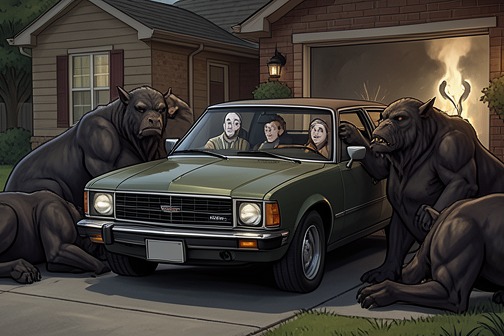
The [Emerald Isle Car-Impact Incident](entity:event-recall-event-emerald-isle-c5ad2f2403ec) was a close-range Sligger attack on a couple’s car in [Emerald Isle](entity:location-recall-location-emerald-isle-58bf45741dc8), [North Carolina](entity:location-recall-location-north-carolina-02c7fd11f230), two nights before a federal team investigated the site. The couple escaped by reversing out of their driveway and struck one creature, turning a terrifying encounter into a rare source of physical evidence. Their account pointed investigators toward the shoreline near [Emerald Isle Woods Park](entity:location-recall-location-emerald-isle-woods-p-4c789cad7055), where they searched for a possible nest but found no confirmation in the described search.
## The Attack and Its Immediate Aftermath
The couple were returning from a movie at about ten o’clock at night. As soon as they stopped in the driveway, several [Sliggers](entity:creature-recall-creature-sliggers-91ee239f1ac5) appeared and crowded over the car, trying to reach them. The suddenness of the attack left the couple trapped inside a vehicle under assault; the husband later described the experience as horrible, while his wife remained unable to sleep afterward.
They escaped by backing rapidly out of the driveway. During their flight, they ran over one of the creatures. The car left behind was visibly damaged, with dents and scratches across it, a concrete trace of the attack that the investigators could inspect. The couple called the police, spent the night at a hotel, and did not return home until the following day, after police told them the monsters were no longer in the area. The account establishes their escape and the collision, but does not report injuries to either person or describe what happened to the other creatures.
## From Collision to Investigation
The attack occurred near a house beside Emerald Isle Woods Park, on the near side of [Bogue Banks](entity:location-recall-location-bogue-banks-54a9c07b0c0f) Island. Two nights later, Ron drove his passengers from [Camp Lejeune](entity:location-recall-location-camp-lejeune-87d2a0cc6035) along Highway 24; after about forty minutes, they crossed the causeway to Bogue Banks and reached the wooded neighborhood. The team had already spent hours examining a dissected specimen, removing eggs developing inside it and taking organ samples. The creature run over during the couple’s escape supplied the connection between the roadside encounter and that wider effort to understand the animals.
The homeowner initially approached the arriving vehicle with a frown, uncertain what to make of the visitors. Ron identified the group as federal-government liaisons assigned to deal with the sea creatures and explained that they wanted both to investigate for signs of a nest and to hear about the couple’s encounter. [Andy](entity:character-recall-character-andy-1d26f3c164d3) looked over the car’s dents and scratches as the man recounted the attack. The damaged vehicle thus served not merely as a remnant of the couple’s ordeal but as part of the investigators’ immediate, on-site assessment.
## The Search Near the Shoreline
The husband had not seen where the creatures came from. He suspected they had emerged from the shoreline behind the house, in the park, and said that the couple had been watching that direction in case more returned. His suggestion was a lead rather than a confirmed account of the animals’ route. Ron nevertheless chose to search there, with Andy agreeing, converting the residents’ observation and suspicion into a focused field investigation.
The team moved through the park’s tall pines and green oak trees, then followed a trail northwest toward the island’s north coast. [Josh](entity:character-recall-character-josh-7784b47d315f) told the searchers to ready their weapons, keep fingers on the safeties, and be prepared to disengage them if danger appeared. They proceeded slowly through the brush, watching for creatures or traces of a nest. The dirt path eventually became an elevated wooden walkway over low ground. As daylight began to fade, Andy raised the possibility of stopping before the team became trapped in the park after dark; Josh noted that about an hour of daylight remained. The available account records a cautious search in progress, not the discovery of a nest or a further encounter during this expedition.
## Place in the Wider Outbreak
The incident arrived amid evidence that Sligger attacks were appearing across a broad stretch of coastline. Mason had already warned that reports from [Georgia](entity:location-recall-location-georgia-6064d11655cc) and [St. Augustine](entity:location-recall-location-st-augustine-e0c5329a1b18) were too far apart to be explained by one local nest; [Denise](entity:character-recall-character-denise-829ff5a7cbf3) concluded that multiple nests, eggs, and creatures must be present and that many people could be killed before their locations were known. The Emerald Isle attack added another household encounter to that expanding pattern, while its suspected connection to a wooded shoreline gave responders a concrete place to investigate.
The team’s search also reflected the emerging logic of the response: locate nests, favor dark, cool, wet habitats near water, and destroy the creatures associated with them. Mason warned that simply blasting Sliggers apart could scatter mutated tissue into the water, where other animals might consume it and continue the contamination through the food chain. Denise likewise urged clean collection and burning of carcasses. Those cautions linked an apparently localized driveway attack to a larger ecological threat associated with a substance believed to have leaked from a Nazi U-boat discovered beneath [Wrecker Island](entity:location-recall-location-wrecker-island-4ce6c099ed50); the compound’s identity and the historical explanation remained unconfirmed in the evidence available at this point. The incident’s decisive consequence was therefore investigative as well as immediate: the collision left evidence, the survivor identified a possible habitat, and the response moved from learning about individual attacks toward searching for the source of further ones.
Event 10
Nest-Clearing Operation at Emerald Isle and Crystal Coast
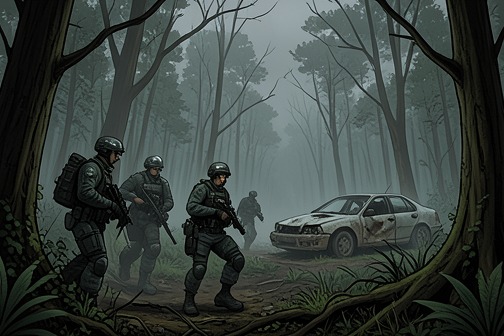
The [Nest-Clearing Operation at Emerald Isle and Crystal Coast](entity:event-recall-event-emerald-isle-crystal-co-8e81f34fa991) is a four-day campaign to locate and eliminate [Sligger nests](entity:object-recall-object-sligger-nests-61f3495a578d) before the creatures can spread further along [North Carolina](entity:location-recall-location-north-carolina-02c7fd11f230)’s waterways. Its decisive achievement is not a claim that the coast has been made safe: the team finds and destroys two nests, establishes a procedure for dealing with them, and then entrusts the continuing search to local authorities. The operation makes eradication a matter of both force and careful disposal, while leaving clear that the work extends beyond the ground its central team has covered.
## Background and Search Conditions
The team had been in North Carolina for four days. Some of that time went to medical analyses of a carcass in the medical building at [Camp Lejeune](entity:location-recall-location-camp-lejeune-87d2a0cc6035); most was spent overseeing the sweep of [Emerald Isle](entity:location-recall-location-emerald-isle-58bf45741dc8) and the rest of the [Crystal Coast](entity:location-recall-location-crystal-coast-6fd0c4b66ca8). The campaign therefore joined investigation of the creatures to fieldwork: understanding the carcass mattered, but finding the places where the animals reproduced was the immediate operational priority.
The search moved through difficult cover rather than along a clearly exposed boundary. In [Emerald Isle Woods Park](entity:location-recall-location-emerald-isle-woods-p-4c789cad7055), the team followed forest trails northwest toward the island’s north coast, scanning trees and brush for signs of nests or creatures. When the dirt path became an elevated wooden walkway over low ground, the searchers slowed to examine the vegetation below. The sun was beginning to set. [Andy](entity:character-recall-character-andy-1d26f3c164d3) worried that the team could be trapped in the woods after dark, while [Josh](entity:character-recall-character-josh-7784b47d315f) judged that about an hour of daylight remained. Their exchange captures the practical constraint on the search: careful inspection was essential, but so was avoiding a dangerous return through cover at night.
## The First Nest and the Second
With help from the Emerald Isle Police Department, a sizable group returned to the place where Josh had shot a creature that had attacked from the water. Ron led the party there, warned everyone to be prepared to shoot, and joined in searching the surrounding vegetation. Within half an hour, they found eggs burrowed in the reeds. The discovery immediately became a fight: sentinel creatures attacked the people entering the area, but the group responded quickly and had ample weapons. The [Sliggers](entity:creature-recall-creature-sliggers-91ee239f1ac5) were killed, collected, and the eggs burned in the nest.
The following day, the search uncovered a second nest about a mile west of the first, nearer the Main Channel. That clearance went more smoothly. The team burned the eggs, killed the aggressive creatures found nearby, and dragged the carcasses away for clean destruction. The contrast between the first encounter, with its sudden attack, and the more orderly second operation shows the beginnings of a method that could be repeated. Nest removal was not simply a matter of finding eggs: the creatures guarding them had to be dealt with, and the remains had to be removed rather than left where other animals might feed on them.
## A Method Built Around Containment
The operation applied a broader warning from Mason: Sliggers favored dark, wet places near water, including shaded thickets and seaside caves, making dense vegetation and waterways important search areas. He also cautioned against merely blowing the creatures apart. Their mutated tissue could enter the water, be eaten by other animals, and carry the contamination onward through the food chain. The danger, as the team understood it, was not confined to a living Sligger or an intact nest; careless killing could leave the conditions for further biological spread behind.
[Denise](entity:character-recall-character-denise-829ff5a7cbf3) had connected the creatures’ unusual mixture of animal characteristics to a suspected mutagenic substance associated with a Nazi U-boat found beneath [Wrecker Island](entity:location-recall-location-wrecker-island-4ce6c099ed50). Her explanation remained a theory awaiting laboratory results, but the practical precaution was firm: every part of a killed animal needed to be recovered and burned so scavengers could not consume tissue containing mutated DNA. At Emerald Isle, collecting the dead creatures and destroying them cleanly made disposal part of the extermination itself. Burning eggs prevented another generation from hatching; removing carcasses was intended to prevent the threat from passing into other animals.
## Results, Limits, and Handoff
After four days working the coastlines with local law enforcement, Ron and Andy judged that city and state authorities could manage the operation from then on. Denise and Josh agreed. The team had not found a nest in the preceding two days, and Ron took that as encouraging evidence that the immediate area was improving. Yet he also said that the entire island still needed to be searched. Denise added that the surrounding inlets and waterways required attention too. The absence of recent discoveries was a reason for cautious confidence, not proof that every nest had been found.
Josh later reported that the team had found two nests near Emerald Isle and killed about a dozen Sliggers. He said the locals had the situation under control and that the group was moving on. The distinction between local progress and the broader crisis remained important: the sweep of Emerald Isle and the Crystal Coast was part of a much larger effort, and the waterways still needed to be scoured. The operation’s lasting contribution was therefore both material and procedural. It removed two breeding sites and their nearby creatures, while demonstrating a sequence of search, armed response, egg destruction, carcass recovery, and clean disposal that could become commonplace elsewhere.
Event 11
Oscar Steals and Transplants Sligger Eggs
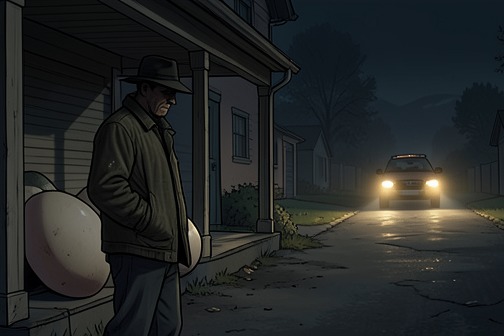
[Oscar Brown](entity:character-recall-character-oscar-brown-78e5d48e2ce0)’s theft and transplant of [Sligger eggs](entity:object-recall-object-sligger-eggs-5956c01548e6) turns a civilian hunt into a deliberate attempt at murder. He joins a search party in [Savannah](entity:location-recall-location-savannah-d61b1a30d8f4) claiming he wants to help destroy nests, but secretly takes two eggs for himself. He then drives back to [Port Arthur](entity:location-recall-location-port-arthur-4c6f8aad7d11) and hides them beneath the porch of his former home, intending for the creatures to attack [Brittney Nelson](entity:character-recall-character-brittney-nelson-cd81fe3ff30f) and [Randy Miller](entity:character-recall-character-randy-miller-0844ec000bb8).
## Arrival in Savannah and the Hunt
[Oscar](entity:character-recall-character-oscar-a322eac993da) reaches Savannah after a grueling thirteen-hour drive from [Texas](entity:location-recall-location-texas-f19b16f8e87c), stopping overnight in Mobile, Alabama. He takes in the city’s parks, public squares, Victorian houses, Gothic churches, and Spanish moss before heading toward the [Savannah River](entity:location-recall-location-savannah-river-135a3a60af07). There, over dinner, he searches online for local groups organizing Sligger hunts. The [Georgia](entity:location-recall-location-georgia-6064d11655cc) police are allowing civilians to join searches, and within minutes Oscar finds a forum, contacts a group, and arranges to meet that evening.
He spends the time before the hunt at Forsyth Park, then drives toward the wetlands between Savannah and [Tybee Island](entity:location-recall-location-tybee-island-39ec99fff360). The group plans to search swampland south of the Savannah River, where the open, waterlogged ground could conceal nests. Two trucks are parked on the quiet road. A thin, middle-aged woman and three men wait nearby, all wearing waders and carrying shotguns. Oscar brings an LED flashlight and his 9mm pistol, though he is unsure how effective it will be against the creatures.
## A Hunt Concealing a Theft
The others believe Oscar has come to help search for and destroy [Sligger nests](entity:object-recall-object-sligger-nests-61f3495a578d). His private aim is different: he wants to take eggs for himself. Staying at the front of the group beside Molly, he hopes to spot a nest before anyone else does; with the hunters’ attention shared, he sees little chance of stealing eggs unnoticed. He therefore suggests that they spread out to cover more ground. Molly agrees only reluctantly and warns him not to get too far away.
After wading through water that sometimes reaches two feet deep, Oscar finds six eggs bunched beneath protective reeds. Each is roughly a foot long and greenish yellow, with a bumpy, leathery surface. He opens his backpack and reaches for one while Molly, about thirty feet away, asks whether he has seen anything. Oscar ignores her, puts one egg into the pack, then takes a second. Their weight surprises him. Only after concealing both does he call the group over and announce that he has found eggs.
The other hunters arrive at a nest containing four football-sized eggs. Molly recognizes them and prepares to shoot them, while praising Oscar for finding the nest. His beaming expression looks to the group like satisfaction at a successful discovery. In fact, he is pleased because he has already taken two eggs and kept his real purpose hidden. The hunt provides the cover he needs: the group has found a nest, but Oscar leaves with a pair of its eggs.
## Return to Port Arthur
Oscar carries the stolen eggs back to Texas and returns to Port Arthur, where he had recently been expelled. Deputy Randy Miller had warned that he would destroy Oscar if he stayed, and Oscar imagines Randy and Brittney celebrating his departure. He is angry at the thought of them laughing and believes he has returned to make things right. In practice, his idea of redress is to put the couple in danger.
Oscar stays on the outskirts of town at a motel just off the highway, avoiding places where Randy or Brittney might see him. He checks the eggs in his backpack: they appear to have remained as cool as they were in the shaded marsh, but their acrid smell has filled the car during the drive. He has kept a window down along the way. The eggs’ condition matters to the plan he has formed: if they hatch, he wants the young creatures to be close to their intended prey.
## Planting the Eggs
Near midnight, Oscar puts the two eggs back into his backpack and drives into town. Brittney’s house backs onto the [Sabine Neches Canal](entity:location-recall-location-sabine-neches-canal-770c8d08a557), a waterway between Port Arthur and [Pleasure Island](entity:location-recall-location-pleasure-island-e5e7d67c1541). He stops a block away, where the streets are quiet and most houses are dark, then walks to the house he once called home. He slips over the chain-link fence and creeps toward the back porch, hoping not to alert Precious, Brittney’s Chihuahua, by making noise.
At the porch, Oscar kneels and removes the first egg from the pack. He pushes it beneath the wooden structure and into the weeds, moving cautiously in case snakes are sheltering there. He stashes it two feet in, checks that the house remains dark, and places the second egg beside it. Then he leaves the yard and returns briskly to his car, proud that the plan has been carried out. He hopes the eggs hatch that night and that the creatures find Brittney and Randy.
## Significance and Aftermath
The episode links the [Sligger crisis](entity:concept-recall-concept-sligger-crisis-76f4a354de84) to human action as well as to the creatures’ capacity to spread. Earlier, [Denise](entity:character-recall-character-denise-829ff5a7cbf3) had warned that reports from distant locations meant multiple nests and that people could be killed before anyone knew where the creatures were. Oscar’s theft makes that danger more difficult to contain: instead of leaving the nest and its eggs where hunters can find them, he transports two eggs across state lines and deliberately hides them at a household he knows.
The wider crisis is later traced in part to movement along coastal waterways. Ron reports that currents carried the creatures east along the [Gulf of Mexico](entity:location-recall-location-gulf-of-mexico-6c8da060fe63) and that Port Arthur is the westernmost reported point. In the broader eradication effort, a nest near the Mississippi at [Baton Rouge](entity:location-recall-location-baton-rouge-aa3c62d8f78f) is destroyed, and searchers find no further nests during a forty-mile sweep of waterways. Against this organized response, Oscar’s act is a private, intentional counterforce: he uses the cover of a public hunt to move the threat into a personal conflict, making the eggs not merely objects of biological danger but instruments of revenge.
Event 12
Sligger Attack at Brittney and Randy's Home
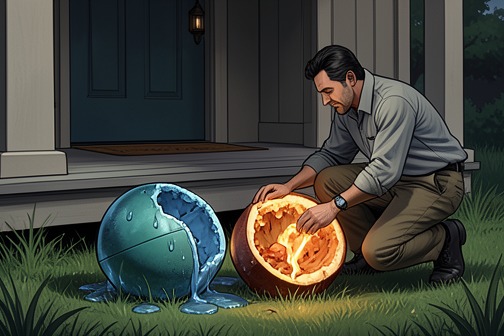
The [Sligger Attack at Brittney and Randy's Home](entity:event-recall-event-brittney-randy-sligger-34e1f743cad5) turns an overlooked nest remnant into an immediate household emergency. Two breached, football-sized eggs beneath the porch are treated as foul-smelling rubbish; hours later, a creature kills Precious in the backyard, and two [Sliggers](entity:creature-recall-creature-sliggers-91ee239f1ac5) rush the house. The episode’s decisive reversal lies in how ordinary precautions and familiar comforts fail to prepare Randy and Brittney for what has hatched nearby.
## The eggs beneath the porch
The danger first announces itself as an unpleasant smell. Randy wonders whether it is gas, while Brittney thinks it resembles rotten eggs and points out that the gas line should run from the street into the house on the other side, about twenty feet away. Randy steps off the porch and kneels to look beneath it. In the grass he can make out two large, broken orbs. He reaches under, finds one cool and smooth, with a sticky side, and pulls it into the light.
The object resembles an enormous egg, about the size of a football, split open but hinged together and empty. Randy retrieves the second one as well. Their putrid odor makes him wince. Brittney guesses that they might be alligator eggs, but Randy rejects the idea because they are far too large. The empty shells raise the central question of the encounter before either person can answer it: if these are eggs, what emerged from them?
## A household mistake
Randy’s response is practical and confident rather than alarmed. He reassures Brittney that even if the animals return, they do not attack people like rattlesnakes or water moccasins; if they do come back, he says, his pistol will be enough. Brittney’s smile and affectionate squeeze of his buttock show that his certainty restores their sense of safety. The pistol seems to reduce the unknown threat to something familiar and manageable.
At Randy’s request, Brittney fetches a black plastic trash bag from the kitchen. He puts the strange shells inside, knots the bag tightly, and tosses it beside the chain-link fence to go out with the rubbish the next day. This disposal removes the immediate odor from their yard, but it also makes the discovered evidence into household waste rather than a warning. The shells are already breached and empty; the story does not establish that discarding them causes the later attack, but their presence makes the creatures’ proximity impossible to dismiss in retrospect.
The couple return to the routine of a Sunday evening. Randy lights the charcoal for the thick porterhouse steaks he has bought, and about an hour later they eat together. They watch a college football game with beers in hand, absorbed in the close contest. The shift from strange eggs to dinner and television is important to the event’s progression: the danger does not arrive as a continuous pursuit but waits just beyond the ordinary rhythm of the house.
## Precious encounters the creature
After nine, Precious, the couple’s shorthaired Chihuahua, goes outside through the vinyl flap of the dog door. In the backyard she smells an unfamiliar animal close by. Activity in the azalea bushes draws her toward them; she barks and runs to their edge, where something lashes out from the foliage. Her yelp carries into the house and brings Brittney to her feet.
Brittney calls for Precious from the back door, but the dog does not answer. The yard is dark because the porch light is not working, leaving Brittney unable to see clearly. She steps onto the lawn, notices that the sulfuric smell has returned, and catches movement in the grass. Thinking it may be Precious, she walks toward it. The failed light and familiar call combine to make the approach a search for a missing pet, not a prepared encounter with a predator.
The shape that rises is much larger than the Chihuahua. At first it is roughly the size of a large dog, hunched in a rounded, tortoise-like posture and apparently eating a small animal. Brittney immediately understands that Precious has been killed. As the creature lifts itself onto its hind legs, its scale becomes clearer: it stands almost five feet tall. It hisses and flails arms that look like thick snakes. Brittney, frozen for a moment by fear and confusion, breaks away and runs back toward the house.
## The attack reaches the house
Randy meets Brittney at the door as she hurries inside. Her alarm tells him that something is wrong, but he has not yet seen what is in the yard. When he looks out, two thin creatures with olive-green skin leap onto the back porch and charge toward the house. Their shiny black eyes catch the light from inside; their jaws gape around needle-like teeth. The sight overturns Randy’s earlier confidence: what he had imagined as a manageable return of an animal is now a direct rush by two visibly dangerous creatures.
Brittney’s urgent demand that he shut the door ends the scene on immediate defensive action. The threat has moved from concealed eggs under the porch, to unseen activity in the bushes, to a creature feeding in the grass, and finally to two attackers at the entrance. The evidence supports neither a completed account of what happens after that command nor a conclusion that the earlier shells contained these particular animals. What it does establish is the escalation from overlooked signs to an attack at the threshold.
## Significance within the outbreak
The household encounter gives intimate, physical form to a wider danger described elsewhere in the crisis: [Denise](entity:character-recall-character-denise-829ff5a7cbf3) recognizes that distant coastal incidents imply multiple nests, eggs, and creatures, and warns that people may be attacked without knowing where the next threat lies. At Randy and Brittney’s home, that uncertainty takes the shape of a smell mistaken for a household problem, empty shells mistaken for rubbish, and a pet that disappears into a dark yard. The attack shows how little warning ordinary domestic routines may offer when Sliggers are already nearby.
The episode also makes the eggs’ emptiness more ominous than their strange appearance. Their broken halves are tangible evidence that something has emerged, but they provide no identification of what is loose or where it has gone. Randy and Brittney can recognize that the shells are unusual without understanding their significance. By the time the danger becomes unmistakable, it is no longer an object under the porch that can be bagged and set beside the fence: it is alive, in the yard, and charging the house.
Event 13
Sligger Attack on Randy and Brittney
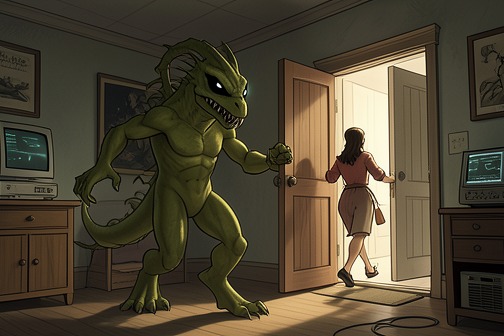
The Sligger attack on [Brittney Nelson](entity:character-recall-character-brittney-nelson-cd81fe3ff30f) and [Randy Miller](entity:character-recall-character-randy-miller-0844ec000bb8) brings the creatures’ violence into a home, where a brief attempt to escape becomes a fatal struggle. The couple are overwhelmed by two [Sliggers](entity:creature-recall-creature-sliggers-91ee239f1ac5), and their deaths later reveal the attack’s personal and wider consequences: the creatures have reached another household, while [Oscar Brown](entity:character-recall-character-oscar-brown-78e5d48e2ce0) recognizes that his own actions helped bring them there.
## The Attack at Home
Brittney first encounters a creature in the yard, where it appears to be eating a small animal. She realizes what has happened to her Chihuahua, Precious, and runs back toward the house. The creature rises to nearly five feet tall; when it hisses and flails its thick, snake-like arms, Brittney’s shock gives way to flight. Her discovery makes the danger immediate, but she reaches the doorway before she can explain what she has seen.
Randy meets her inside, bewildered by her alarm. Then two thin, olive-green creatures leap onto the back porch and charge the house. Their shiny black eyes catch the indoor light, and their jaws gape around needle-like teeth. Brittney cries for Randy to shut the door, but the Sliggers reach it first. White claws dig into the wood as their tentacles seize the edge and wrench the door open. The threshold that might have protected the couple instead becomes the point of entry: the creatures force their way into the kitchen, and Brittney and Randy run for the front door.
## The Couple’s Last Struggle
The Sliggers caught Randy and Brittney before they could reach the front door. A tentacle swipe brought each of them down, then gripped and dragged them back toward their attackers. As the couple rolled to face the creatures, clawed limbs cut into their bodies. Their attempted escape had become a fight for survival, but the animals’ speed and grasping appendages left them little room to resist.
Randy struck the creature over him, landing one punch to its face. It recoiled, but when he tried again, it caught his hand in its jaws and bit it off. The other Sligger slashed Brittney across the chest and then bit into her breast. The attack left both victims bleeding and increasingly unable to fight back; the creatures continued tearing at and eating them until their strength failed.
Randy and Brittney died facing one another, their eyes meeting as their vision faded. That final image gives the assault a brutal intimacy: the couple’s last awareness is not only of the creatures killing them, but of each other’s terror. Their deaths turn a household invasion into a confirmed double fatality and establish the Sliggers’ feeding as part of the danger, not merely the violence of the initial attack.
## Discovery and Complicity
The attack’s aftermath was discovered by Deputy Sonny, who recognized the smell of rotting flesh as he entered the house. By the front door he found Randy and Brittney’s bodies, mostly reduced to dark, sticky skeletons, their ribs and limb bones exposed while their heads remained largely intact. Their milky eyes were still open. Sonny vomited, went back outside to collect himself, and then reported what he had found. The scene confirmed the couple’s deaths and showed how thoroughly the Sliggers had fed after overwhelming them.
Nearly two weeks later, Oscar Brown was still living in a motel rather than returning to the house. He had originally planned to move back after Randy and Brittney were out of the picture, but waited for the police investigation to finish and then reconsidered. The creatures had killed there once, he feared, and might return; their attack had made the home he expected to reclaim feel unsafe to occupy.
The threat had not remained confined to that house. [Oscar](entity:character-recall-character-oscar-a322eac993da) watched local news report at least two more deaths elsewhere in Brittney’s neighborhood, along the [Sabine Neches Canal](entity:location-recall-location-sabine-neches-canal-770c8d08a557), with the attacks seemingly moving south toward the ocean. The waterways offered a route away from the original scene, while Oscar’s decision to remain distant from them was itself a response to the spreading danger.
His relief at Randy’s death was inseparable from the knowledge that he had helped cause further deaths. Oscar still believed his plan to get rid of Randy had succeeded and that Brittney deserved what happened to her; he also felt some lingering affection for Brittney. But the creatures he had brought from the [East Coast](entity:location-recall-location-east-coast-7405f96629bf) were now killing people beyond the couple he had targeted, and he understood those deaths as his responsibility too. Pride and a sense of justice contended with melancholy and guilt, leaving him in an emotional turmoil he tried to escape by turning to his marijuana stash. The attack therefore marks both a household tragedy and a widening consequence of Oscar’s scheme: his intended revenge did not end with Randy and Brittney, but helped carry the Sligger threat into a larger community.
## Regional Meaning and Containment
The deaths at the house belonged to a crisis already extending across distant coastal locations. [Denise Baddington](entity:character-recall-character-denise-baddington-f3dc1168d215) warned that the attacks reported in [Georgia](entity:location-recall-location-georgia-6064d11655cc) and the discovery of [Sligger eggs](entity:object-recall-object-sligger-eggs-5956c01548e6) at [St. Augustine](entity:location-recall-location-st-augustine-e0c5329a1b18) were too far apart to be explained by one nest: multiple nests, eggs, and creatures could be distributed along the coast, making further attacks likely and their locations difficult to predict. The attack on Randy Miller and Brittney Nelson gave that warning a domestic, fatal form, but it was one instance of a broader infestation rather than an isolated cause of it.
The creatures’ origins also connected individual attacks to an ecological threat. Denise Baddington’s tissue analysis had not identified them, but residue from the Nazi U-boat beneath [Wrecker Island](entity:location-recall-location-wrecker-island-4ce6c099ed50) remained under examination. She suspected the residue would reveal a compound designed to induce genetic mutation; their varied marine traits, she proposed, could reflect generations of feeding on other species and incorporating prey DNA. Later, [Ron Tully](entity:character-recall-character-ron-tully-88a6cd8c2ea9)’s team concluded that coastal currents had carried the creatures along the [Gulf of Mexico](entity:location-recall-location-gulf-of-mexico-6c8da060fe63) from somewhere farther west, with [Port Arthur](entity:location-recall-location-port-arthur-4c6f8aad7d11) the westernmost reported location. The attacks along the Sabine Neches Canal fit a pattern of movement through connected waterways, although the evidence did not establish that the couple’s deaths caused that spread.
Containment required more than locating and destroying individual animals. Four days after the creatures broke into a hotel room in [Baton Rouge](entity:location-recall-location-baton-rouge-aa3c62d8f78f), [Army Reserve](entity:organization-recall-organization-army-reserve-4a1f0ea4dabd) troops found and destroyed a nest near the [Mississippi River](entity:location-recall-location-mississippi-river-50469fcfa0c8). Ron Tully’s team searched northward with the troops as far as [St. Francisville](entity:location-recall-location-st-francisville-8adcf79b8b37); after finding no further nests, they judged the spread stopped. The search covered another forty miles of waterways without a new sighting. In his assessment to the [U.S. Department of the Interior](entity:organization-recall-organization-3258133097f6), Ron Tully also recorded the creatures’ asexual reproduction and rapid adaptation, and reported that those exterminated had been disposed of without leaving remains that could contaminate the ecosystem. The household attack thus sits within a chain of discovery, waterway surveillance, and eradication whose stakes extended from human lives to the possibility of further biological contamination.
Event 14
Sligger Outbreak in Port Arthur
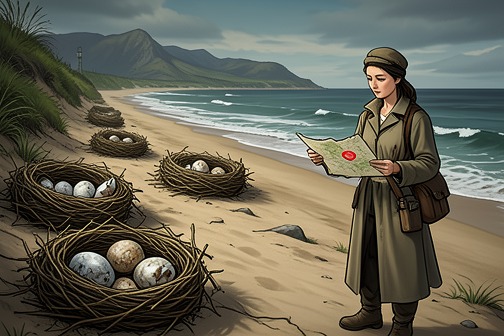
The [Sligger Outbreak in Port Arthur](entity:event-recall-event-port-arthur-sligger-6b6a67b06097) carried the coastal crisis into [Texas](entity:location-recall-location-texas-f19b16f8e87c) and revealed that its spread was not only a natural consequence of the creatures’ behavior. The reports traced their movement along waterways toward the Gulf, while [Oscar](entity:character-recall-character-oscar-a322eac993da)’s private revenge had helped bring them west. What began as an expanding series of attacks thus became both an ecological emergency and a reckoning with the human act that had intensified it.
## Causes and the expanding threat
The outbreak took shape against a widening pattern of discoveries. After an attack at a [Georgia](entity:location-recall-location-georgia-6064d11655cc) campground and clear video of [Sligger eggs](entity:object-recall-object-sligger-eggs-5956c01548e6) on a beach in [St. Augustine](entity:location-recall-location-st-augustine-e0c5329a1b18), [Denise](entity:character-recall-character-denise-829ff5a7cbf3) concluded that the distant locations could not be explained by a single nearby nest: multiple nests, eggs, and creatures must be spread along the coast. Her warning was stark. The creatures could be anywhere, and further attacks might be the first sign that they were present. Separate attacks near St. Augustine and [Sawgrass](entity:location-recall-location-sawgrass-3f414c3453d3) reinforced that the threat was already distributed across [Florida](entity:location-recall-location-florida-1618e1042117).
Investigators had a possible explanation for the creatures’ unusual biology, but not a confirmed one. Tissue analysis had yielded no conclusive identification. Denise was awaiting results from residue taken from the [Wrecker Island Nazi U-boat](entity:object-recall-object-wrecker-island-nazi-u-54590a6609d4), where an unknown substance might have been developed to induce genetic mutation. She suspected that generations of creatures had acquired traits from marine animals they ate. The theory connected the outbreak to a substance that had leaked into the ocean many years earlier, but the test results were still pending; the proposed origin remained a hypothesis, not a settled finding.
The immediate westward pattern was described in terms of the water itself. Investigators concluded that coastal currents had carried the creatures along the [Gulf of Mexico](entity:location-recall-location-gulf-of-mexico-6c8da060fe63), moving east from somewhere farther west. [Port Arthur](entity:location-recall-location-port-arthur-4c6f8aad7d11), a small city on the Texas-[Louisiana](entity:location-recall-location-louisiana-2de999a335e6) border, was then the westernmost reported point. Reports from the [Sabine Neches Canal](entity:location-recall-location-sabine-neches-canal-770c8d08a557) also placed attacks in other parts of Brittney’s neighborhood, apparently moving south toward the ocean. The pattern made waterways both a suspected route of spread and a practical guide for searching, without establishing that every attack had the same immediate source.
## Oscar’s role and the human cost
The outbreak’s personal cause emerged through Oscar’s account of what had happened and what he had done. He had brought the creatures from the [East Coast](entity:location-recall-location-east-coast-7405f96629bf). His original plan was to return to his house after Brittney and Randy were out of the picture, but he waited for the police investigation to finish and then became afraid the creatures would return to the house where they had killed before. He remained at a motel instead. His fear of another attack did not undo his part in bringing the danger to Texas.
Almost two weeks after Brittney and Randy died, Oscar watched local news report at least two more deaths along the canal. He recognized that the consequences were no longer confined to the people he had targeted: the creatures he had brought west were spreading and killing others. His feelings remained divided. He took pride in having achieved his revenge against Randy and believed Brittney had deserved what happened, yet he also understood that the later deaths were his responsibility. The same act that had seemed to him a successful personal settlement had become a wider danger, with victims beyond his original plan.
## Emergency response and ecological safeguards
The scale of the Gulf-state attacks brought a federal response. A national news update reported that the president had declared a [National State of Emergency](entity:state-recall-state-national-state-of-emerg-24102c67e894) and deployed the [National Guard](entity:organization-recall-organization-national-guard-677bd1cd70b9) and [Army Reserve](entity:organization-recall-organization-army-reserve-4a1f0ea4dabd) to locations including Port Arthur. Troops were to assist local law enforcement in searching near waterways for creatures and nests; the stated search area in the county extended along the shorelines of lakes, inlets, and rivers. The president identified the animals’ rapid reproduction as a threat to public safety and the ecosystem, and had not ruled out bio-terrorism as a cause of the new spread. The report made clear that the authorities were treating the crisis as more than a sequence of isolated attacks.
The recommended response depended on finding nests rather than reacting only after creatures appeared. Mason advised searching dark, wet places near water, including shaded thickets and seaside caves, and destroying both nests and the creatures associated with them. He also warned against simply blasting the animals apart: scattered tissue could enter the water, be eaten by other animals, and carry mutated DNA farther through the food chain. Denise therefore insisted that all tissue be recovered and carcasses collected and burned, so scavengers could not feed on contaminated remains. These precautions made disposal part of the containment effort, not an afterthought to killing the creatures.
## Containment and wider significance
The later campaign in Louisiana showed how authorities pursued the connected threat farther along the Mississippi. Four days after creatures broke into a hotel room in [Baton Rouge](entity:location-recall-location-baton-rouge-aa3c62d8f78f), Army Reserve troops found and destroyed a nest near the river. Ron’s team continued north with the searchers, reaching [St. Francisville](entity:location-recall-location-st-francisville-8adcf79b8b37) without finding another nest. The teams covered another forty miles of waterways after locating the Baton Rouge nest and found no further creatures there. Reports from the Gulf of Mexico were also improving, with federal and local authorities encountering the animals less often. Ron’s assessment recorded asexual reproduction, rapid adaptation to different environments, and the clean removal of remains so they would not contaminate the ecosystem.
Those later results documented progress in the wider response; they do not establish that Port Arthur itself was the source of every Gulf Coast attack or that the outbreak there ended at the same moment. Its significance lies in how it joined several scales of consequence: an expanding route of reports along waterways, a suspected ecological mechanism that remained under investigation, a nationwide mobilization, and Oscar’s belated recognition that his revenge had endangered people he had never intended to involve. The emergency required authorities to pursue creatures and nests while also preventing their remains from becoming another means of spread.
Event 15
Three-Person Sligger Attack at Perdido Key
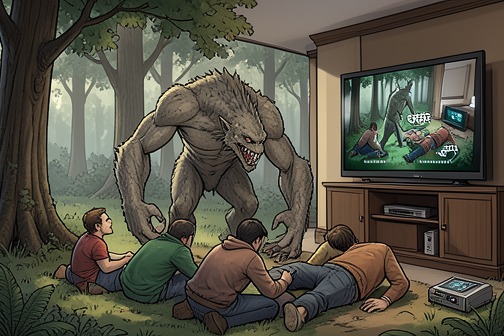
The [Three-Person Sligger Attack at Perdido Key](entity:event-recall-event-perdido-key-9cf786743be2) marked a deadly westward expansion of the sligger crisis and prompted [Florida](entity:location-recall-location-florida-1618e1042117) to declare a state of emergency. Three people were killed near [Perdido Key](entity:location-recall-location-perdido-key-b4f70f3c844b) State Park; the attack’s resemblance to earlier sligger assaults turned a local tragedy into evidence of a widening regional threat.
## Background and Discovery
The attack became known to Ron and [Andy](entity:character-recall-character-andy-1d26f3c164d3) through a television report in their hotel room. A graphic identified a deadly animal attack, and the anchor reported that three people had been killed near Perdido Key the previous night. The victims had not yet been identified, but authorities said their deaths were clearly the result of an animal attack. At the scene, police noted wounds matching those found on victims in earlier sligger incidents, making the creatures the suspected attackers.
## Confirmation and Geographic Significance
The attack also changed the crisis’s official status. The television report said Florida’s governor had declared a state of emergency and hoped the president would deploy [Army Reserve](entity:organization-recall-organization-army-reserve-4a1f0ea4dabd) troops to assist. The broadcast thus placed the three deaths within a response that could extend beyond local law enforcement, even before the victims had been identified.
Three nights after the killings, Ron’s team examined the victims at the Escambia County Sheriff’s Office morgue. Their bite and claw marks confirmed for the investigators that sliggers had killed them. [Josh](entity:character-recall-character-josh-7784b47d315f), confronting the wounds, remembered the state troopers killed in the cavern on [Wrecker Island](entity:location-recall-location-wrecker-island-4ce6c099ed50), whose bodies had also been slashed, squeezed, and bitten. The physical evidence connected the Florida deaths to the earlier attacks, while the memory gave that connection a personal weight for the state patrol captain.
The team read the location as a clue to the creatures’ movement. Andy reasoned that their presence at Perdido Key meant they were likely coming from somewhere farther west, and the sheriff added that news outlets had reported a possible sligger attack in [New Orleans](entity:location-recall-location-new-orleans-ac6617a07d7e). When Andy searched for further reports, he found several attack sites to the west. Investigators concluded that coastal currents had carried the creatures along the [Gulf of Mexico](entity:location-recall-location-gulf-of-mexico-6c8da060fe63), moving east from somewhere west of Florida; the westernmost reported point was [Port Arthur](entity:location-recall-location-port-arthur-4c6f8aad7d11), [Texas](entity:location-recall-location-texas-f19b16f8e87c), near the [Louisiana](entity:location-recall-location-louisiana-2de999a335e6) border.
The emerging route shaped the deployment that followed. Ron preferred to take his team to Louisiana and investigate the [Mississippi River](entity:location-recall-location-mississippi-river-50469fcfa0c8), whose possible role in the spread concerned him most. He proposed dividing the troops into three groups: one to begin at Port Arthur, another to continue westward from their position in Florida, and a third to reach the Mississippi immediately and follow the creatures’ trail upriver. The three deaths at Perdido Key therefore became more than a local casualty count: in the investigation, they helped turn a suspected animal attack into a geographic warning about an expanding, waterborne threat.
## Outbreak Context and Wider Response
The killings unfolded amid evidence that the creatures were not confined to a single nest. [Denise](entity:character-recall-character-denise-829ff5a7cbf3) had reasoned that reports from the campground in [Georgia](entity:location-recall-location-georgia-6064d11655cc) and the discovery of eggs on a Florida beach near [St. Augustine](entity:location-recall-location-st-augustine-e0c5329a1b18) were too far apart to point to one local outbreak: multiple nests and creatures must be spread along the coast. That meant authorities could not know where the next attack would occur before it happened. The deaths at Perdido Key belonged to a pattern whose geographic reach was already outpacing the ability to locate its source.
The investigation offered a possible explanation for the creatures’ unusual biology, though not a confirmed one. Denise’s tissue analysis had yielded no conclusive identification. Residue recovered from the [Wrecker Island Nazi U-boat](entity:object-recall-object-wrecker-island-nazi-u-54590a6609d4) was still awaiting test results, but she suspected it might be the [U-boat mutagenic substance](entity:object-recall-object-u-boat-mutagenic-subst-d27770af73e8): a compound created to induce genetic mutation when introduced into an organism’s DNA. In her account, generations of creatures feeding on other marine species could acquire traits from their prey, helping explain their mixture of characteristics. The theory framed the outbreak as a continuing biological process, not simply a series of isolated animal attacks.
News of the spreading danger altered ordinary life far beyond the attack sites. National broadcasts advised people to stay indoors at night and away from the water until authorities declared areas safe. In [Sweetboro](entity:location-recall-location-sweetboro-a5aa48839f69), still shaken by its own earlier attack, some residents left the coast to stay with inland friends or relatives; others boarded windows, secured their homes, and stocked ammunition. Meanwhile, social media circulated jokes and monster-film memes, even as civilian groups organized to search for nests. Those reactions ranged from retreat and household preparation to improvised hunting, revealing how unevenly communities translated a common warning into action.
The official response eventually moved from reporting and deployment toward eradication. Four days after the [Sliggers](entity:creature-recall-creature-sliggers-91ee239f1ac5) broke into a hotel room in [Baton Rouge](entity:location-recall-location-baton-rouge-aa3c62d8f78f), Army Reserve troops found and destroyed a nest near the Mississippi. Searchers continued north with Ron’s team, covering forty more miles of waterways without finding another nest before reaching [St. Francisville](entity:location-recall-location-st-francisville-8adcf79b8b37). Ron’s assessment reported that the spread up the river had been eliminated and emphasized that the discovered creatures had been destroyed without leaving remains that could contaminate the ecosystem and mutate its animals. That later containment did not erase the uncertainty exposed at Perdido Key: the crisis had demanded a regional search precisely because each new attack could signal a larger, still-hidden population.
## The Attack as a Turning Point in the Investigation
The killings first reached Ron’s team not through a field report but through a television screen in their hotel room. Andy, idly changing channels while Ron showered, stopped at a broadcast marked “DEADLY ANIMAL ATTACK,” turned up the volume, and sat upright as the report linked the three deaths to the sliggers. By the time Ron returned, Andy’s stunned expression had made the news personal to the team. The later morgue examination transformed that alarming report into a working certainty: the bite and claw wounds matched the creatures’ known attacks. The event’s narrative turn lies in that passage from distant bulletin to physical evidence, which made the growing western reports actionable for investigators.
Event 16
Delacroix Airboat Tour Attack and Disappearance
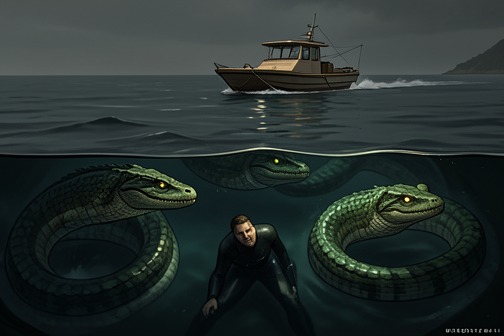
The [Delacroix Airboat Tour Attack and Disappearance](entity:event-recall-event-9343dc2df03f) brings the sligger crisis into the bayou south of [New Orleans](entity:location-recall-location-new-orleans-ac6617a07d7e): guide [Paul Fontenot](entity:character-recall-character-paul-fontenot-070cc4825563) is pulled beneath the water, and three creatures swarm the boat carrying four Houston lawyers on a bachelor party outing. Their disappearance becomes evidence that the threat has reached the Gulf’s waterways, while the attack’s abrupt shift from spectacle to slaughter shows how little protection ordinary confidence or distance from the coast can offer.
## Background and Setting
The attack takes place during an airboat outing in the bayou south of New Orleans. Its passengers are a group of Houston lawyers celebrating a bachelor party, and their excursion initially centers on the familiar performance of handling local wildlife. One of them offers another hundred dollars, and Paul accepts the opportunity to impress the visitors. He sizes up an alligator at roughly four to five feet long, estimates it to be about four years old, and jumps into shallow water to seize it. His practiced handling of the reptile gives the scene a public, almost demonstrative quality: he holds it against his chest while the men point their phones at him and take pictures.
That confidence meets a threat the group does not recognize until it is already in the water. The attack is consistent with the wider danger described elsewhere in the crisis: sliggers favor dark, cool places near water, and their presence in separate locations indicates multiple nests and animals scattered across a broad area. The bayou is not an isolated setting outside the outbreak but part of the connected waterways through which the creatures are spreading.
## The Attack on the Water
The first sign of danger is a dark, ropelike form wrapping around the alligator. It tears the reptile away from Paul and pulls it into the bayou. Paul is left stunned; before he can regain control of the situation, water erupts in front of him. In the brief glimpse provided by the boat’s flashlight, the attacker has olive-green, glistening skin, huge eyes, and a long-toothed snout. It seizes Paul around the waist and drags him below the surface.
The men on the boat realize that their guide is in trouble, then hear splashing again and try to direct their lights toward it. Instead, three creatures burst from beneath the water and surround the craft. The flashlight beams expose attackers far more frightening than anything the passengers had imagined. They begin climbing aboard, turning the small boat from a place of observation into the center of the attack.
The lawyers, previously watching and photographing Paul’s encounter with the alligator, huddle together in the middle of the craft. Their screams of fear, pain, and despair are silenced, and the bayou grows calm again. The contrast is stark: the men had treated the wildlife encounter as entertainment, but the animals in the water were not part of a performance they could control. The narrative does not show the group escaping or establish the individual fates of the passengers; it leaves the attack in the sudden quiet that follows the violence.
## Disappearance and Confirmation
The later account places the outing among the disappearances reported on the bayou south of New Orleans. [Denise](entity:character-recall-character-denise-829ff5a7cbf3) notes that people have gone missing there, including a group of Houston lawyers on a bachelor party trip. Ron connects those reports to a migration that may have moved up the [Mississippi River](entity:location-recall-location-mississippi-river-50469fcfa0c8). The later report therefore confirms the group’s disappearance as part of the crisis, but does not supply a recovery, identification, or separate confirmation of each passenger’s death. Paul, last seen being dragged beneath the surface, is likewise not shown returning.
That uncertainty matters to the event’s place in the wider response. At first, an attack in one location might be mistaken for a local danger; reports from distant places, however, make that explanation untenable. Denise reasons that widely separated incidents mean multiple nests and creatures are present, with further attacks likely before their locations can be identified. The missing people in the bayou become one part of that accumulating evidence: the threat is not confined to a single shoreline or one known nest.
## Regional Significance
The bayou attack also fits the authorities’ developing account of how the creatures are spreading. Ron’s team later concludes that coastal currents have carried them along the [Gulf of Mexico](entity:location-recall-location-gulf-of-mexico-6c8da060fe63) from somewhere farther west, while missing-person reports and victim images point to activity in and around waterways. The group’s disappearance supports the scale of that concern without, on its own, proving a precise route or origin for the particular attackers.
Investigators suspect that the creatures’ mutations are connected to an unknown substance associated with a Nazi submarine found beneath [Wrecker Island](entity:location-recall-location-wrecker-island-4ce6c099ed50). Denise’s tissue analysis has not established what the animals are, and testing of submarine residue remains pending; her theory is that a mutagenic substance could help explain their mixed marine characteristics and evolution through generations feeding on other species. The attack does not resolve that scientific uncertainty. It makes its practical stakes immediate: a creature hidden beneath the water can take prey and attack a boat before those aboard understand what they are facing.
As the crisis expands, officials stress both the need to find nests and the danger of careless disposal. Mason warns that killing sliggers by blasting them apart could scatter mutated tissue into the water and return it to the food chain. Denise likewise urges the clean collection and burning of carcasses so scavengers cannot consume remains carrying mutated DNA. In that context, the bayou is more than the setting for a terrifying disappearance: it is part of an aquatic environment where the creatures’ movement, feeding, and potential contamination are linked. The excursion’s final silence marks the human cost of that expanding problem, while the subsequent reports turn the missing group into a warning that the outbreak has moved beyond the familiar Atlantic coast.
Event 17
Mississippi River Attack in New Orleans
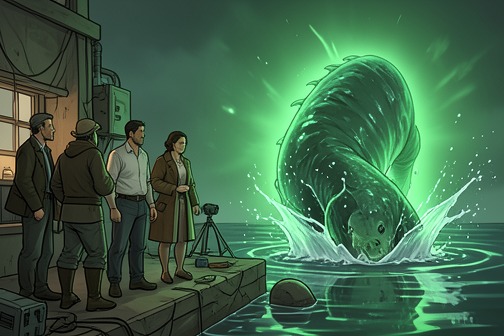
The [Mississippi River Attack in New Orleans](entity:event-recall-event-7f2aae983a1a) turns a gathering beside the water into a two-person emergency: Daniel vanishes into the river, and Steve drowns trying to reach him. The creature remains unseen, but its force is unmistakable. The attack makes the river more than a setting for danger; it becomes the route and instrument through which danger acts, leaving witnesses on shore with no way to intervene.
## Background and Setting
The incident belongs to a wider coastal emergency in which reports of [Sliggers](entity:creature-recall-creature-sliggers-91ee239f1ac5) had already prompted warnings to stay indoors at night and avoid the water until authorities declared areas safe. Elsewhere, people formed civilian search groups, while police searched the [Savannah River](entity:location-recall-location-savannah-river-135a3a60af07) after the destruction at the [Jekyll Island](entity:location-recall-location-jekyll-island-7cbdcc811b4c) campground. Those responses show how the threat had altered ordinary access to shorelines and rivers. In [New Orleans](entity:location-recall-location-new-orleans-ac6617a07d7e), however, the danger arrives not during a search but amid a group of friends gathered at the water’s edge.
The attack begins with an uncertain visual clue. As Kimmy photographs the young men, the flash briefly illuminates something dark green behind them, resembling a large, wet snake. A heavy splash follows. The flash offers only an instant of visibility, not enough to identify the creature or give the group time to act. Daniel is suddenly gone from the spot where he had been standing, and the friends can only scan the dark river for him.
## The Attack
A hand breaks the surface, and Daniel’s head appears in the water. He calls for help, visibly terrified, but his brief return does not mean he has escaped: he begins moving upriver as though something is pulling him. Steve leads the others along the waterfront sidewalk to keep pace. Daniel calls out again, his speech labored, and then disappears beneath the surface. The shift from a sudden snatching to a drawn-out pursuit along the bank gives the friends a view of their companion’s danger without giving them control over it.
After the water agitates again, Steve runs down the rocky shoreline and dives in. He swims toward Daniel’s last position, pauses to look around, then searches underwater by feel, hoping to find something he can grasp. He finds nothing and resurfaces for air. At that moment, something wraps around his thigh and tightens with immense strength. Steve cries out and is pulled underwater. He struggles toward the surface but cannot break free; as water enters his airway, he loses consciousness and drowns. Unlike Daniel’s fate, Steve’s death is explicitly established. Daniel’s disappearance strongly suggests the same predator has taken him, but the scene does not show his recovery or confirm his death.
## Witnesses and Consequences
Kimmy and Melissa remain on shore as the rescue attempt fails. A crowd of passersby gathers around the screaming women, but the river has gone quiet, and the people watching cannot reach either man. That contrast defines the immediate aftermath: there are witnesses, a visible shoreline, and a growing crowd, yet no one can identify or confront what is beneath the surface. Steve’s voluntary attempt to rescue his roommate becomes a second victimization rather than a recovery.
The event therefore exposes a practical limit of the public advice to avoid the water: an attack can unfold in front of companions before they understand what is happening, and entering the river to help can place another person within the creature’s reach. The scene’s most consequential reversal is the change from a group watching a photograph being taken to a crowd watching an empty, quiet river. The camera flash offers one fragment of evidence; it cannot prevent the attack or explain it.
## Place in the Wider Crisis
Reports gathered by Ron’s team later showed attacks west of their location. The investigators identified [Texas](entity:location-recall-location-texas-f19b16f8e87c), including [Port Arthur](entity:location-recall-location-port-arthur-4c6f8aad7d11) near the Texas–[Louisiana](entity:location-recall-location-louisiana-2de999a335e6) border, as the furthest west point where Sliggers had been reported, and Ron proposed dividing troops among Port Arthur, the [Florida](entity:location-recall-location-florida-1618e1042117) route, and the [Mississippi River](entity:location-recall-location-mississippi-river-50469fcfa0c8). That response does not establish the New Orleans attack as the origin of the western spread, but it places the episode within a crisis increasingly understood through connected waterways and dispersed reports. The New Orleans scene gives that broader pattern an intimate human cost: a creature’s movement through the river is encountered not as a map or report, but as a roommate dragged beneath the surface and a second man who cannot bring him back.
Event 18
Nationwide Sligger Emergency and Extermination Campaign in the United States
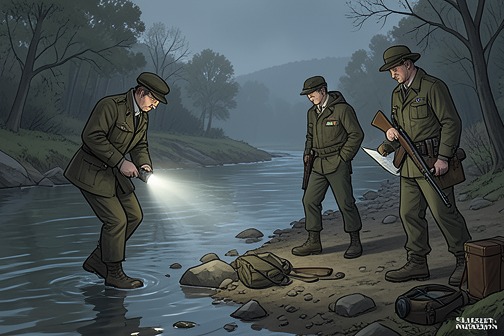
The [Nationwide Sligger Emergency and Extermination Campaign in the United States](entity:event-recall-event-sligger-74ac79d6b26c) was the escalating, multi-agency effort to locate and destroy [Sliggers](entity:creature-recall-creature-sliggers-91ee239f1ac5) after their spread proved too broad for isolated local responses. A second wave along the [Gulf of Mexico](entity:location-recall-location-gulf-of-mexico-6c8da060fe63) and the [Mississippi River](entity:location-recall-location-mississippi-river-50469fcfa0c8) transformed a coastal crisis into a national emergency: troops were divided among [Texas](entity:location-recall-location-texas-f19b16f8e87c), [Florida](entity:location-recall-location-florida-1618e1042117), and the Mississippi corridor, while police and civilian hunters searched shorelines and waterways. The campaign’s ambition was national, but its method was painstakingly local—search every bank, culvert, sewer, and other possible hiding place, then dispose of the creatures so their mutations could not continue to threaten the ecosystem.
## From Coastal Outbreak to National Threat
The case for a wider response emerged as reports accumulated from distant locations. After an attack on a campground in [Georgia](entity:location-recall-location-georgia-6064d11655cc) and clear video of [Sligger eggs](entity:object-recall-object-sligger-eggs-5956c01548e6) on a Florida beach at [St. Augustine](entity:location-recall-location-st-augustine-e0c5329a1b18), [Denise Baddington](entity:character-recall-character-denise-baddington-f3dc1168d215) concluded that the sites were too far apart to belong to one nest. Multiple nests and creatures, she warned, could be scattered along the coast, with their locations unknown until they attacked. Her assessment shifted the problem from containing a single outbreak to anticipating many simultaneous ones. [Eaver Robinson](entity:character-recall-character-eaver-robinson-6ca7b53d756e) asked whether a government contact could issue a national warning; [Denise](entity:character-recall-character-denise-829ff5a7cbf3) identified [Gina Taylor](entity:character-recall-character-gina-taylor-251aff2de5b1), her contact at the [U.S. Fish and Wildlife Service](entity:organization-recall-organization-u-s-fish-and-wil-fcda5a1300d0), as someone she could notify.
The spread also unsettled communities that had already experienced an attack. In [Sweetboro](entity:location-recall-location-sweetboro-a5aa48839f69), [South Carolina](entity:location-recall-location-south-carolina-0e7f9eaed279), residents heard that Sliggers had appeared at multiple [East Coast](entity:location-recall-location-east-coast-7405f96629bf) locations while the town’s own previous attack remained fresh in memory. Some locked their homes and drove inland to stay with relatives or friends; others boarded windows, fortified doors, stocked ammunition, and cleaned their guns. [Mason Parker](entity:character-recall-character-mason-parker-89e6e9e56699) went among his constituents to reassure them that he would not let the creatures gain a foothold on the town’s shores. He asked residents to watch for eggs or nesting signs near the water, but directed them to report discoveries to him and leave the danger to the sheriff’s department and his deputies.
National news broadcasts and social media widened public awareness. People were advised to remain inside at night and avoid the water until authorities declared areas safe. Some responded with jokes and monster-movie memes; others organized East Coast hunting groups. The two responses—humor and armed volunteer action—appeared side by side as people tried to make sense of a threat that was both frightening and geographically diffuse.
## Local Searches and Civilian Participation
The campaign’s volunteer dimension took shape before the federal mobilization reached its fullest scale. In [Savannah](entity:location-recall-location-savannah-d61b1a30d8f4), police concentrated along the [Savannah River](entity:location-recall-location-savannah-river-135a3a60af07) after the campground attack on [Jekyll Island](entity:location-recall-location-jekyll-island-7cbdcc811b4c). Civilian hunters, meanwhile, organized to search beyond populated areas, where they could carry guns without interfering with law enforcement activity. [Molly Foster](entity:character-recall-character-molly-foster-b720a99f9d0b), raised in a military family and taught to hunt by her father, assembled friends for an armed search. She brought her shotgun; the group wore chest waders for the stretches where they expected to move through water.
After dark, six hunters set out near [Old Fort Jackson](entity:location-recall-location-old-fort-jackson-03d3f7f528ef), moving east along the Savannah River. They searched the riprap shoreline, passed the wooded stretch beyond the fort, and continued toward the SeaPoint Industrial Terminal. The fort’s tightly packed rocks and the terminal’s similarly dense banks offered little room for a large animal to nest, so they searched those sections quickly. The route shows the practical demands of civilian participation: volunteers had to judge likely habitat, work around security and populated areas, and cover a long river system whose inlets and islands multiplied the search area.
When Molly’s group encountered and destroyed [Sligger nests](entity:object-recall-object-sligger-nests-61f3495a578d), she called the police, gave the location of the bodies for disposal, and waited for officers rather than continuing downriver. They were already two miles from their vehicles, and the remaining distance to the Atlantic Ocean was another ten miles, before accounting for the inlets and island shores. Molly recognized that even one river search could take months. Later, after the national emergency was declared, she called Deputy Norman Linneman, who had responded on three previous occasions to clean up after her group’s river searches. Their repeated contact illustrates how volunteer work could become a continuing partnership with local police: hunters found and destroyed nests, while officers responded to the resulting scenes.
## Federal Emergency and Deployment Plan
The crisis expanded again when reports placed Sliggers in the Gulf of Mexico, including Alabama and [Louisiana](entity:location-recall-location-louisiana-2de999a335e6), and along the Mississippi River. In a discussion of the western spread, [Ron Tully](entity:character-recall-character-ron-tully-88a6cd8c2ea9) and his colleagues concluded that coastal currents had carried the creatures eastward from somewhere farther west. Texas was then the furthest-west reported point, at [Port Arthur](entity:location-recall-location-port-arthur-4c6f8aad7d11), on the Texas–Louisiana border. Ron considered the Mississippi the most pressing route of expansion and proposed dividing the forces into three parts: one third to begin at Port Arthur, one third to continue westward from Florida, and one third to reach the Mississippi immediately and follow the creatures upriver.
The president’s televised declaration of a [National State of Emergency](entity:state-recall-state-national-state-of-emerg-24102c67e894) made the federal escalation public. The announcement said that [Army Reserve](entity:organization-recall-organization-army-reserve-4a1f0ea4dabd) troops would assist the [National Guard](entity:organization-recall-organization-national-guard-677bd1cd70b9) in eradicating the creatures. When Molly asked how the situation had become so serious after the East Coast effort appeared to be succeeding, Linneman explained that attacks had appeared around the Gulf and along the Mississippi. Because that river reaches far into the country, containment now required a much broader sweep. Law enforcement and military personnel would begin along the Gulf Coast, while other forces searched the coast and rivers feeding into the ocean. The stated scope extended to every waterway, culvert, sewer, cave, and forest that might conceal the creatures.
The deployment reflected Ron’s three-part strategy. In [New Orleans](entity:location-recall-location-new-orleans-ac6617a07d7e), Sergeant Billingsly briefed National Guard troops on the danger of the Sliggers’ toxic appendages and ordered them killed without explosives, following Denise’s warning. His unit was assigned to clear the area from New Orleans up the Mississippi River, while two infantry divisions advanced from Florida and Texas. Ron judged the plan well suited to containing and eliminating the invasive species. At the wharf, Billingsly distributed handguns and ample ammunition magazines to the federal visitors accompanying his unit. The New Orleans Police Department joined the operation, working culverts and crevices farther from shore as the Guard searched the water’s edge.
A separate coastal search shows the same emphasis on coordinated, systematic coverage. Twenty deputies walked in a line, examining a strip extending one hundred feet inland from the shoreline and moving together across the ground. Sheriff [David Mittenfeld](entity:character-recall-character-david-mittenfeld-b6fab5dfd34e) joined the line with his four visitors. This method turned an open-ended search into a defined sweep, but the scale of the coastline and connected waterways meant that the work had to be repeated across many areas.
## Eradication, Disposal, and the Limits of Scale
Destroying visible creatures was only one part of the response. The campaign treated their remains as an ecological hazard: Linneman told Molly that the same protocol used on the coast would apply elsewhere, with bodies collected and burned so that mutations could not continue to affect the ecosystem. Molly agreed that disposal was necessary to prevent further mutation. That rule connected field operations to the suspected origin of the creatures. Denise’s tissue analysis had not identified them conclusively, and tests on residue from the Nazi U-boat beneath [Wrecker Island](entity:location-recall-location-wrecker-island-4ce6c099ed50) were still pending. She suspected the substance might have been created to induce genetic mutation; the possibility that Sliggers acquired traits from the marine animals they ate offered a provisional explanation, not a confirmed finding.
The campaign therefore confronted two kinds of uncertainty at once: where the creatures were and how far their biological effects might extend. The coastal-current explanation offered a route to follow, while the existence of multiple nests and the appearance of a Gulf wave warned that sightings could not define the full extent of the infestation. Even with local police, National Guard troops, federal personnel, and volunteers working together, the terrain resisted neat boundaries. Molly pointed out that the wetlands around New Orleans seemed almost infinite, and that searching them all would be an ordeal. The national response could bring people and weapons to the field quickly, but its success depended on exhausting a landscape of interconnected rivers, shores, and hidden spaces—a task whose magnitude the book leaves visible even as the sweep begins.
Event 19
Baton Rouge Hotel Attack
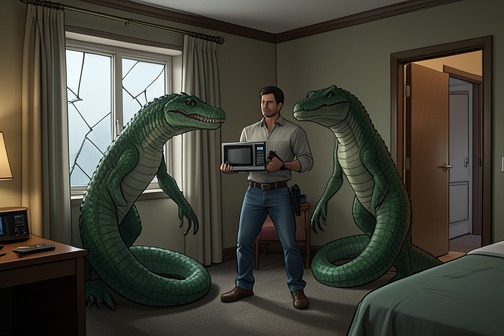
The [Baton Rouge Hotel Attack](entity:event-recall-event-d081e87e3d52) brings the [Sligger crisis](entity:concept-recall-concept-sligger-crisis-76f4a354de84) into a place [Josh Moody](entity:character-recall-character-josh-moody-abb95c0f8066) and [Denise Baddington](entity:character-recall-character-denise-baddington-f3dc1168d215) had reason to regard as a refuge: their hotel room, after an evening together. A creature smashes through the window, a second appears, and the couple is trapped between the animals and the room’s exit. [Josh](entity:character-recall-character-josh-7784b47d315f) kills both with a microwave and six carefully used bullets. Their escape turns a sudden domestic intrusion into another urgent report in a widening outbreak, one later followed by the destruction of a nest near the [Mississippi River](entity:location-recall-location-mississippi-river-50469fcfa0c8).
## Background and the expanding outbreak
The attack occurs amid mounting evidence that [Sliggers](entity:creature-recall-creature-sliggers-91ee239f1ac5) are appearing across a broad area rather than remaining confined to earlier sites. Reports from [St. Augustine Beach](entity:location-recall-location-st-augustine-beach-f7ef53593375) and [Sawgrass](entity:location-recall-location-sawgrass-3f414c3453d3) describe separate attacks, while the distance between locations leads Denise Baddington to warn that multiple nests and creatures may already be spread along the coast. The threat is therefore not simply a known group of animals that can be tracked from one site: new attacks may reveal previously undiscovered nests, with little warning to nearby communities.
Investigators are also developing an explanation for the creatures’ unusual biology. [Denise](entity:character-recall-character-denise-829ff5a7cbf3)’s tissue analysis has not identified what they are, and testing of residue recovered from the Nazi submarine beneath [Wrecker Island](entity:location-recall-location-wrecker-island-4ce6c099ed50) is still pending. She suspects that the residue may be a substance designed to induce genetic mutation, potentially explaining why the creatures display traits associated with different marine animals after generations of feeding on other species. The origin remains a theory rather than a confirmed laboratory finding, but its ecological implications already shape the response: [Mason Parker](entity:character-recall-character-mason-parker-89e6e9e56699) warns that killing a Sligger carelessly could scatter mutated tissue into the water, where other animals might eat it and continue the contamination through the food chain.
By the time reports are considered along the [Gulf of Mexico](entity:location-recall-location-gulf-of-mexico-6c8da060fe63), coastal currents are thought to have carried the creatures eastward from somewhere farther west. [Port Arthur](entity:location-recall-location-port-arthur-4c6f8aad7d11), [Texas](entity:location-recall-location-texas-f19b16f8e87c), is identified as the westernmost reported point. [Ron Tully](entity:character-recall-character-ron-tully-88a6cd8c2ea9) proposes dividing forces among Port Arthur, [Florida](entity:location-recall-location-florida-1618e1042117), and the Mississippi River, whose possible northward route concerns him most. The [Baton Rouge](entity:location-recall-location-baton-rouge-aa3c62d8f78f) encounter occurs within this effort to understand and contain an outbreak whose geography is still being revised as new reports arrive.
## The breach and fight
The attack begins with a noise at the window. Josh sees a dark shape outside; moments later the glass shatters under a forceful impact, and a Sligger breaks into the room. Josh infers that it may have come out of the river, climbed the bluff, and crossed the street after being drawn by the light in the ground-floor room. That route is his explanation for how a creature reached the hotel, not a confirmed account of its movements.
The first animal lands inside and moves between Josh and the chair holding his handgun. A second Sligger appears at the window. Denise retreats into a corner, while the first creature has already cut off the way to the door. The room’s ordinary furnishings suddenly determine the couple’s chances: with his weapon inaccessible and the creatures closing in, Josh pulls a microwave away from the dresser, lifts it, and hurls it at the first animal’s head. The blow stuns it long enough for him to reach his pistol.
Josh has seven bullets. He fires three into the head of the second Sligger, the one nearest Denise, then turns and fires three at the first. He does not spend time checking the first animal before redirecting his aim; each shot is part of a hurried attempt to stop two attackers with a limited supply of ammunition. Both creatures fall dead. Josh keeps the final bullet unused, a last reserve that proves unnecessary but makes the scarcity of his options explicit.
## Escape and immediate aftermath
Once the danger has passed, Denise rushes to Josh and holds him tightly, asking whether he is all right. He says he will be once his heart starts working again; Denise answers with a nervous laugh that she feels the same. Their exchange briefly restores the intimacy interrupted by the attack, but it does not erase what has happened in the room. The couple decides to leave and tell the front desk, reasoning that the staff must have heard the gunshots. They open the door and walk slowly toward the lobby.
The scene establishes how quickly an apparently ordinary setting can become an exposure point. The creatures’ route into the room is inferred from the river, bluff, street, and window light, while the attack itself offers no time for a planned response. Josh’s earlier advice to search dark, cool places near water helps explain why waterways and their surroundings matter to the wider campaign, but this Sligger reaches the hotel rather than being encountered at a nest. The broken window also marks a decisive change in the couple’s immediate circumstances: a private evening becomes an emergency that must be reported to others.
## Connection to the river search and containment
Four days after the hotel breach, [Army Reserve](entity:organization-recall-organization-army-reserve-4a1f0ea4dabd) troops sweeping the area locate and destroy a nest near the edge of the Mississippi River. Ron’s team continues north with the troops. The search reaches [St. Francisville](entity:location-recall-location-st-francisville-8adcf79b8b37) without finding another nest, and the teams examine forty more miles of waterways without discovering another creature. On that basis, they become convinced that the spread up the Mississippi has been stopped. The later report does not establish that the hotel attackers came from the nest, but the sequence places the attack within the same regional emergency and shows why finding breeding sites, not merely killing visible animals, becomes central to containment.
The response also treats carcass disposal as part of the battle. Denise cautions that every bit of tissue must be recovered and the bodies burned so scavengers cannot carry mutated DNA onward through the food chain. Ron promises to communicate the procedure, and the subsequent assessment describes the extermination as clean, leaving no remains that could contaminate the ecosystem. It also records the creatures’ ability to reproduce asexually and evolve rapidly in response to different environments. The hotel attack is therefore more than a close-range survival episode: it demonstrates the immediate danger of a breach while the larger campaign must address reproduction, movement through waterways, and the environmental consequences of killing the animals.
Event 20
End of the Sligger Crisis
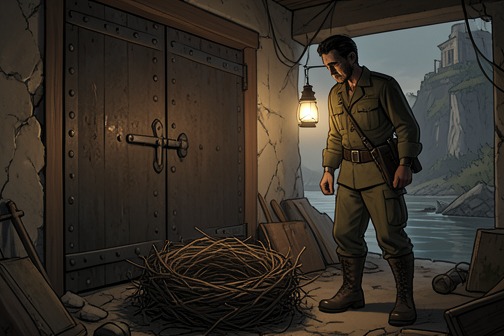
The [End of the Sligger Crisis](entity:event-recall-event-sligger-e49e9a078f70) is the conclusion of the nationwide campaign against the [Sliggers](entity:creature-recall-creature-sliggers-91ee239f1ac5): after a final nest was destroyed near the [Mississippi River](entity:location-recall-location-mississippi-river-50469fcfa0c8), coordinated searches found no further creatures, and the president officially declared the emergency over. The victory is concrete but not absolute in its explanations. The Sliggers are gone, while the origin and composition of the suspected mutagenic compound remain unresolved.
## From Coastal Outbreak to National Emergency
The crisis had appeared at first to be a series of coastal attacks, but reports from widely separated locations changed the threat’s scale. [Denise](entity:character-recall-character-denise-829ff5a7cbf3) recognized that the campground attack in [Georgia](entity:location-recall-location-georgia-6064d11655cc) and footage of [Sligger eggs](entity:object-recall-object-sligger-eggs-5956c01548e6) on a beach in [Florida](entity:location-recall-location-florida-1618e1042117) could not be explained by a single nearby nest. Multiple nests and creatures must be distributed along the coast, she warned, leaving authorities unable to know where the next attack would occur. Her prediction that many people would die framed the outbreak as a spreading emergency rather than an isolated local danger.
The reports unsettled [Sweetboro](entity:location-recall-location-sweetboro-a5aa48839f69), [South Carolina](entity:location-recall-location-south-carolina-0e7f9eaed279), where the memory of the previous year’s attack was still fresh. Some residents locked their homes and drove inland to stay with family or friends; others fortified doors, boarded windows, and stocked ammunition. [Mason Parker](entity:character-recall-character-mason-parker-89e6e9e56699) walked through town to reassure residents, asking them to watch for eggs or nesting signs near the water while directing them to report discoveries to him and the Sheriff’s Department rather than investigate on their own. The crisis altered ordinary life before any new attack reached the town: preparation meant both retreating from the coast and trying to defend it.
National broadcasts eventually advised people to remain indoors at night and avoid the water until authorities declared areas safe. Public fear also produced less official responses. Social media circulated jokes made from sea-monster movie stills, while groups of civilian hunters organized searches for nests. In [Savannah](entity:location-recall-location-savannah-d61b1a30d8f4), [Molly Foster](entity:character-recall-character-molly-foster-b720a99f9d0b), raised in a military family and taught to hunt by her father, assembled friends for a nighttime search near [Old Fort Jackson](entity:location-recall-location-old-fort-jackson-03d3f7f528ef). Such efforts showed how the emergency mobilized people beyond formal agencies, even as the danger and need for coordination remained.
## The Threat and the Rules of Eradication
The investigators’ account of the creatures’ origin remained a theory, not a confirmed explanation. Denise’s tissue analysis had not identified what the Sliggers were. Residue samples from the [Wrecker Island Nazi U-boat](entity:object-recall-object-wrecker-island-nazi-u-54590a6609d4) were still awaiting laboratory results, but she suspected the unknown compound had been created to induce genetic mutation. The creatures’ combination of traits from different marine animals seemed consistent with generations feeding on other species and mutating with the DNA of their prey. [Ron Tully](entity:character-recall-character-ron-tully-88a6cd8c2ea9) considered the theory viable in light of Nazi experimentation during [World War II](entity:time-recall-time-world-war-ii-d4353dde1684), but the compound itself had not yet been identified.
The suspected mechanism shaped the practical rules for killing the creatures. Mason Parker explained that [Sligger nests](entity:object-recall-object-sligger-nests-61f3495a578d) favored dark, cool or wet places near water: shaded thickets and seaside caves were among the likely search sites. Finding the nests mattered most, but destroying creatures by explosives alone could scatter mutated tissue into the water. If other animals ate those remains, the contaminated material could enter the food chain and continue the cycle. Denise therefore insisted that carcasses be collected cleanly and burned, rather than left for scavengers. Eradication required not just killing the visible monsters but preventing their remains from becoming another route of spread.
The Sliggers’ behavior made that work difficult. Mason and [Josh Moody](entity:character-recall-character-josh-moody-abb95c0f8066) warned investigators about the creatures’ speed, the toxin in their claws, and the number of bullets needed to kill them. In his later assessment, Ron also recorded their ability to reproduce asexually and evolve rapidly in response to different environments. These traits helped explain why the response could not stop at the destruction of a single nest: searchers had to cover connected waterways and remove the creatures without leaving potentially contaminating tissue behind.
## The Final Searches
The last phase followed the creatures inland along the Mississippi River. Investigators concluded that coastal currents had carried them along the [Gulf of Mexico](entity:location-recall-location-gulf-of-mexico-6c8da060fe63), moving east from somewhere west of their location; [Texas](entity:location-recall-location-texas-f19b16f8e87c), with reports from [Port Arthur](entity:location-recall-location-port-arthur-4c6f8aad7d11) on the Texas-[Louisiana](entity:location-recall-location-louisiana-2de999a335e6) border, was then the westernmost point where they had been reported. The route broadened the problem beyond the original [East Coast](entity:location-recall-location-east-coast-7405f96629bf) alarm and made the waterways themselves central to the search.
Four days after creatures broke into a hotel room in [Baton Rouge](entity:location-recall-location-baton-rouge-aa3c62d8f78f), sweeping [Army Reserve](entity:organization-recall-organization-army-reserve-4a1f0ea4dabd) troops located and destroyed a nest near the Mississippi River. They continued north, with Ron’s team searching alongside them, and reached [St. Francisville](entity:location-recall-location-st-francisville-8adcf79b8b37) without finding another nest. Ron’s assessment recorded that searchers had covered forty more miles of waterways after the Baton Rouge discovery without seeing a single monster. Reports from the Gulf of Mexico were also becoming more encouraging: federal and local authorities were encountering Sliggers less frequently, and Ron judged the situation to be under control. Based on the manpower deployed, he estimated that the remaining creatures could be destroyed in a relatively short time.
That assessment was followed by a wider accounting. Over the next month, thousands of people spent hundreds of hours searching waterways along the Sliggers’ paths. The [National Guard](entity:organization-recall-organization-national-guard-677bd1cd70b9) and Army Reserve troops returned home, while local authorities continued their sweeps until they were satisfied the creatures were gone. A week before the closing account, the president had officially declared the crisis over. The country’s activity shifted from eradication to mourning for those killed and to the unresolved questions of how the infestation had spread so quickly, why it had appeared from different points of origin, and how the creatures had come to exist.
## Resolution and Unanswered Questions
The ending distinguishes the successful defeat of the creatures from certainty about their origin. The suspected compound from the rusted Wrecker Island Nazi U-boat might have contributed to their creation through accidental ingestion, but its makeup was still unknown and scientists were continuing to analyze samples. The story closes the immediate threat without presenting that investigation as complete. The biological cause remains a question even after the animals themselves have been eliminated.
The crisis’s end is therefore both an operational achievement and a fragile return to ordinary life. The searches have found no further Sliggers, and the threat is described as over; the people left behind still have to mourn the dead and wait for answers. In Sweetboro, Mason Parker and [Eaver Robinson](entity:character-recall-character-eaver-robinson-6ca7b53d756e) spend a sunny September day at the beach. Their presence beside the water reverses the precautions that had defined the emergency, but it does not erase what the coast has meant: the place of nests, attacks, and searches is again a place where they can sit together. The calm is real, while the scientific explanation remains unfinished.
Event 21
Global Monster Catastrophe in *Age of Monsters*
The global monster catastrophe in *Age of Monsters* begins not with an explanation but with a remembered place: an Oregon general store where [Jonah](entity:character-recall-character-jonah-b2b9e5099135) has stopped after fishing. A failing broadcast reveals destruction in [New York City](entity:location-recall-location-new-york-city-65df0a129d4c) and reports of similar events around the world; outside, a T. rex is eating a man. The sudden shift from distant images to a living predator makes the end of the world both immense and brutally immediate.
## The regional crisis before the rupture
The catastrophe follows a distinct coastal emergency in which [Sliggers](entity:creature-recall-creature-sliggers-91ee239f1ac5) appeared across widely separated parts of the [East Coast](entity:location-recall-location-east-coast-7405f96629bf). After reports of an attack in [Georgia](entity:location-recall-location-georgia-6064d11655cc) and eggs on a [Florida](entity:location-recall-location-florida-1618e1042117) beach, [Denise](entity:character-recall-character-denise-829ff5a7cbf3) concluded that multiple nests and creatures were spread along the coast, making further attacks likely. Her account of residue from the Nazi U-boat beneath [Wrecker Island](entity:location-recall-location-wrecker-island-4ce6c099ed50) raised a possible origin in a mutagenic substance, but the results were still pending and her explanation remained a theory. The earlier crisis had already shown communities changing their behavior: residents of [Sweetboro](entity:location-recall-location-sweetboro-a5aa48839f69) left for inland homes or fortified their houses, while national broadcasts urged people to stay indoors at night and away from the water. This episode does not establish that the later global catastrophe was caused by Sliggers. Instead, the transition from a coastal infestation to a worldwide collapse widens the scale of the book’s threat: the first emergency could still be mapped along shorelines and waterways, while the new one appears across continents.
## Jonah at the general store
The catastrophe reaches Jonah during an otherwise unremarkable return from a day on the river. He lives in a rustic cabin in the [Siskiyou Forest](entity:location-recall-location-siskiyou-forest-e974c5579585), north of town, and the general store is the last stop before open wilderness. Recent rains had grounded his guide-pilot work, and this fishing trip was his first time out of the cabin in two weeks. He comes in wet and smelling of the river, thinking about frying his catch and buying supplies. That ordinary purpose gives way only when the store’s clerk, absent from the counter, is called back by an impatient customer.
The small group waiting inside includes Jonah, a woman in work clothes, and a large bearded man in a hunting jacket. Jonah reads the woman’s flannel, heavy jacket, boots, and concealed ring finger as signs that she may be a soldier’s wife; that is his guess, not information he knows. When she checks her phone during the broadcast, she says her husband is in the Navy and would have called. Her unanswered expectation of contact places the distant disaster inside a personal uncertainty, even as Jonah has only just emerged from weeks of relative isolation.
## A city on the screen
The clerk brings out an old black-and-white television and plugs it in beneath the cash register. Its war-zone images first make the crisis appear like a familiar report of buildings under attack. Then the picture clarifies enough to show the New York City skyline burning. The broadcast is a fragile connection to a world Jonah has not been following: the clerk says the Internet is down, and the television’s audio cuts out while the images continue. Buildings collapse against the darkness of a citywide blackout, their fires remaining visible where the rest of the skyline has gone dark.
The interruption makes the information both vivid and incomplete. The people in the store see enough to know that destruction is underway but lose the commentary that might explain it. Before the audio fails, the report has said that the events are beginning elsewhere too. The clerk identifies [New York](entity:location-recall-location-new-york-f84f7f10ee10), Los Angeles, Chicago, London, Paris, and Beijing as places named in the broadcast. The scale is no longer that of one city under attack, yet the group has no reliable means to understand what connects the scenes. A man’s suspicion of terrorism is rejected by the clerk, but no alternative explanation is supplied before the television becomes their only window onto the crisis.
## The threat enters the parking lot
The decisive reversal comes when the group leaves the store. Jonah nearly collides with the woman as she stops; he catches her by the shoulders and looks toward the parking lot. Between the store and the gas pump stands a dinosaur, recognizable as a T. rex. It is eating the bearded customer who walked out ahead of them. The monster is no longer an indistinct image transmitted from a city thousands of miles away: it occupies the everyday space outside the store and is already attacking someone from the group’s brief encounter.
Shots startle the animal, which snaps at empty air. The brief interruption does not drive it off. It turns back toward the people, apparently connecting them with the shots, then charges with its jaws open. The scene ends on that forward rush rather than on an escape, counterattack, or explanation. The immediate outcome for Jonah and the woman is left unresolved in this excerpt; the catastrophe’s first local encounter remains suspended at the instant the predator closes the distance.
## The remembered beginning
The opening frames the event through a phrase about how everybody remembers where they were when the world ended. It then narrows that collective claim to Jonah’s particular recollection: he was out fishing, nearly missed the disaster, and had stopped for supplies. The structure makes location and routine part of the event’s meaning. A remote store at the edge of wilderness seems far from the burning skyline, but the broadcast and the animal outside collapse that distance in stages: first the screen carries news from across the world, then a monster makes the crisis physically present.
The contrast with the earlier Sligger response is one of scale and knowledge. Officials and residents had tried to identify coastal nests, follow reports, and organize searches; even those efforts could not prevent scattered attacks. In Jonah’s opening scene, the television announces simultaneous upheaval across major cities, its explanation disappears with the sound, and the first monster appears without warning in a parking lot. The remembered beginning offers no overview of how the world fell or how the creatures arrived. It establishes instead the disorienting sequence by which a person encounters the end: an ordinary errand, a failing image of distant collapse, and a predator already close enough to charge.